It was a nice bit of symmetry for Randall Thompson.
Two weeks ago, he was among those in attendance at Denver Country Club for an Evans Scholars Selection Meeting, helping interview the caddies who were finalists for the college scholarship.
Fifty years earlier, Thompson was on the other side of the questioning. He also was a finalist for the Evans Scholarship at a Selection Meeting at Denver Country Club. The difference was, back then in the late 1960s, Thompson remembers about 15 people attended the meeting, whereas this year it was about 110.
Either way, the stakes were high. Thompson went on to earn the full tuition and housing scholarship. And it was recently announced that a dozen current Colorado caddies have landed Evans Scholarships, with most destined to live at the house Thompson once did — 1029 Broadway in Boulder — and going to school at the University of Colorado beginning in the fall.
Nowadays, an Evans Scholarship is estimated to be worth $100,000 if renewed for four years.
The scholarship will “not make A difference in my life, but THE difference,” noted Oswaldo Morales, one of the fortunate 12 recipients from Colorado.
The brainchild of Charles “Chick” Evans, winner of a U.S. Open and two U.S. Amateurs, the scholarship dates back to 1930 and has produced more than 10,600 alums nationwide at 19 universities, including over 460 at CU since the 1960s.
A total of about 965 Evans Scholars are currently enrolled across the country, including a record 62 starting this school year at CU. It’s estimated that 275 scholarships will be awarded nationwide this cycle.
The Illinois-based Western Golf Association/Evans Scholars Foundation, which administers the Evans Scholarship, recently announced the new recipients from Colorado.
The WGA has long partnered with the CGA in supporting the scholarship in Colorado. The Evans Scholarship, awarded to high-achieving caddies with significant financial need, is a flagship program for the CGA. With bag-tag sales and Par Club contributions, Colorado donors fully fund the year-to-year scholarship costs at the CU Evans Scholars house.
To qualify for an Evans Scholarship — one of the nation’s largest privately funded scholarship programs — applicants must have excellent caddie records and academic results, show strong character and leadership, and demonstrate financial need. Thirty-two Coloradans applied for the Evans Scholarship this school year.
This year’s class of Colorado Evans Scholarship recipients includes eight young men and four young women. Currently, about one-quarter of CU Evans Scholars are women. Of the dozen, two each caddied at Cherry Hills Country Club, Lakewood Country Club and the Roaring Fork Club in Basalt. A record-tying four incoming Scholars started caddying at the Solich Caddie & Leadership Academy — at either CommonGround Golf Course or Meridian Golf Club. The Academy has produced 17 Evans Scholars since debuting in 2012.
Overall, the incoming group has averaged a 3.8 grade-point average on a 4.0 scale in high school and 116 caddie loops. Seven are members of the National Honor Society. Two will receive three-year scholarships as they’re currently college freshmen. Two are classmates at Basalt High School.
Here are the 12 new Evans Scholars from Colorado:
— Payton Brown of Denver, (Denver) East High School. Caddied at Denver Country Club.
— George Conway of Centennial, Cherry Creek HS. Caddied at Solich Caddie & Leadership Academy at Meridian Golf Club.
— Kaia Dameron of Lakewood, Bear Creek HS (2017 graduate). Caddied at Lakewood Country Club. Is a freshman at the University of Denver.
— Isabell Deak of Colorado Springs, Air Academy HS. Caddied at Broadmoor Golf Club and at Seattle Golf Club.
— Anderson Gillmore of Broomfield, (Westminster) Academy of Charter Schools. Caddied at Lakewood Country Club. The younger brother of current Evans Scholar Jordan Gillmore.
— Kyndall Hadley of Centennial, Smoky Hill HS. Caddied at Solich Caddie & Leadership Academy at CommonGround Golf Course and at Cherry Hills Country Club.
— Oswaldo Morales of Basalt, Basalt HS. Caddied at Roaring Fork Club.
— Cole Prins of Highlands Ranch, Mountain Vista HS (2017 graduate). Caddied at Colorado Golf Club. Is a freshman at University of Colorado-Denver.
— Vincent Scarato of Broomfield, Homeschooled. Caddied at Cherry Hills Country Club.
— Samuel (Alex) Seibert of Basalt, Basalt HS. Caddied at Roaring Fork Club.
— Helina Seyoum of Denver, Bishop Machebeuf HS. Caddied at Solich Caddie & Leadership Academy at CommonGround Golf Course.
— Quincy Slaughter of Aurora, Aurora Central HS. Caddied at Solich Caddie & Leadership Academy at CommonGround Golf Course and at Sankaty Head Golf Club in Nantucket, Mass.
All but Hadley (Northwestern) are planning to attend CU.
Among those in attendance for the Selection Meeting at Denver Country Club on Jan. 18 were John Kaczkowski, WGA president and CEO, and new WGA chairman Frank Morley, along with numerous WGA directors and staffers. Many staff members and volunteer leaders from the CGA were also on hand, in addition to plenty of Evans Scholars alums.
“Each of these deserving Evans Scholars epitomizes what our program has been about since its creation in 1930,” Morley said in a WGA release. “Their dedication, hard work and sacrifice is humbling, and we are honored to be able to help them pursue their dreams.”
Evans Scholars have proven to be very high achievers in college, averaging a 3.3 GPA and a 95 percent graduation rate.
Over the last 88 years, the Evans Scholarship has provided more than $365 million worth of tuition and housing to caddies. The annual scholarship costs for Evans Scholars run about $20 million.
This month’s Evans Scholars Selection Meeting was the ninth of an anticipated 20 that will be held nationwide during this academic year.
For those interested in donating to the Evans Scholars Foundation, CLICK HERE.
]]>
The Evans Scholarship for caddies is one of golf’s favorite charities, but things didn’t look very good a decade ago for the part of the program based at the University of Colorado.
The house at 1029 Broadway in Boulder (left) has been the home of the CU Evans Scholars since the 1960s. For the great majority of the half-century since, the norm has been 40-50 caddies living at the house any given school year, receiving full tuition and housing scholarships at CU.
But for the three school years beginning in 2005-06, the numbers at the CU Evans Scholars house dipped below 30 for the first time since the building was purchased in November 1968 to house the caddies.
There were just 28 CU Evans Scholars in 2005-06, 27 in 2006-07 and 29 in 2007-08. The long-term health of the Colorado chapter was in question, and it’s not unprecedented for the Illinois-based Western Golf Association, which administers the scholarship nationwide, to close an Evans Scholars house if things aren’t working out.
“I think I was” worried when the numbers of CU Scholars dropped into the 20s, said Geoff “Duffy” Solich, a CU Evans Scholar alum and now the WGA’s state chairman for Colorado. “We thought at first it might have been an abberation, but that was concerning.”
But at that pivotal time, instead of things going south to the point of no return for the CU Evans Scholars, the situation rebounded — and in a major way. And now, due to a variety of reasons, the number of Evans Scholars at CU starting this school year was a record 62, with three-quarters of them having caddied in Colorado.
That means that in the course of a decade, the caddies based at the house have more than doubled.
“I am really excited about the growth of the program in Colorado and especially excited about the quality of young men and women we are seeing as finalists,” George Solich, who played a key role in the turnaround on several fronts, said via email. “The need is greater than ever, so our ability to change more lives through the Evans Scholarship is rewarding beyond words. From a community-living standpoint, the energy, enthusiasm and quality of experience for the kids is so much greater when the Scholarship house is bursting at the seams.”
The WGA has long partnered with the CGA in supporting the scholarship at CU. The Evans Scholarship, awarded to high-achieving caddies with significant financial need, is a flagship program for the CGA. Through the association’s bag-tag sales and Par Club contributions, Colorado donors fully fund the year-to-year scholarship costs at the CU Evans Scholars house.
With the soaring cost of college, it’s now estimated that the scholarship is worth an average of $100,000 if renewed for four years.
To qualify for an Evans Scholarship, applicants must have excellent caddie records and academic results, show strong character and leadership, and demonstrate financial need.
Last week, more than 100 people — including alums, many representatives of the CGA and WGA, and other supporters of the program — interviewed finalists for the incoming class of Scholars at Denver Country Club. Coincidentally, that’s where scholarship founder Charles “Chick” Evans won one of his Western Amateurs, in 1912, before later capturing titles in the U.S. Amateur (twice) and the U.S. Open. Nationwide, the Evans Scholarship dates back to 1930 and has produced more than 10,600 alums.
Thirty-two Colorado caddies applied for the scholarship this time around.
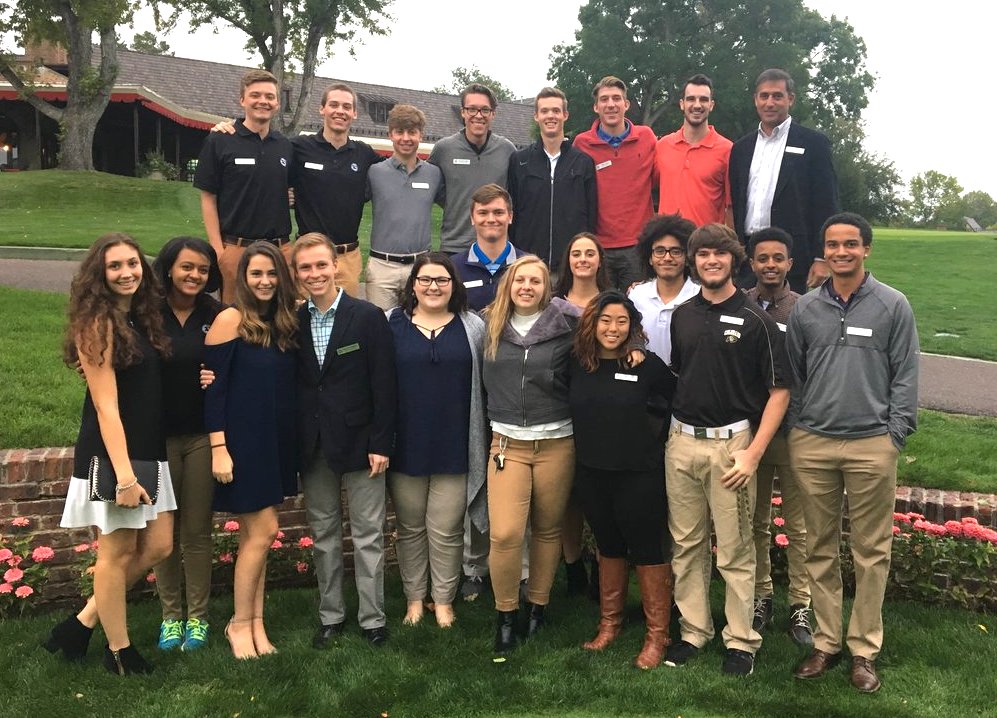 Among the reasons the number of Evans Scholars at CU (some of whom are pictured at left) has surged in the last decade are:
— The creation of the Solich Caddie & Leadership Academy, starting at the CGA-owned CommonGround Golf Course. The program is named after the aforementioned Solich brothers, George and Duffy, both CU alums and longtime major supporters of the program. The Academy, now with chapters at CommonGround, Meridian Golf Club and in Grand Junction, has produced more than 7,000 caddie loops over the last six years, as well as plenty of Evans Scholars.
— The WGA’s long-stated goal of reaching 1,000 Evans Scholars in school nationwide by 2020. The figure for this school year is 965, who are attending 19 universities around the country, with scholarship costs reaching $20 million annually. Nationwide, Evans Scholars are a high-achieving bunch, averaging a 3.3 grade-point average and a 95 percent graduation rate.
— The creation of a staff position at the CGA dedicated to caddie devolopment and recruitment, initially funded by George Solich. Erin Gangloff and Emily Olson have both played key roles at the CGA in that regard over the last decade.
— The $6 million expansion and renovation of the CU Evans Scholars house, which was completed early in 2016 under the guidance of project manager Rick Polmear, a University of Michigan Evans Scholars alum. The project added about 2,000 square feet of finished space, making room for roughly 10 additional Scholars to live there. “We call it a house that’s better than new,” said Jeff Harrison, the WGA’s senior vice president of education.
— Concerted effort by WGA directors in Colorado, including former state chairman Bob Webster and his successor, Duffy Solich, to identify and bring forward qualified candidates for the Scholarship, and to build support for the program financially and otherwise.
— And, of course, as a practical matter, the rebound in the economy following the Great Recession that hit almost 10 years ago. That’s helped money flow much more readily into the program, not only in Colorado but nationwide.
“In my view, the growth (of the number of CU Evans Scholars) is due to several factors,” George Solich noted. “First, our focus at the CGA on developing and promoting strong caddie programs throughout the state is starting to pay off. Second, it is undeniable the Solich Caddie & Leadership Academy is reaching high-performing inter-city kids that are proving to be very deserving of an Evans Scholarship. These young men and women in many cases would have never stepped foot on a golf course without this program at CommonGround Golf Course and now Meridian Golf Club. Now we have (many) kids from this program earning a full tuition and housing scholarship to CU.
“And finally, with our partnership with CU Boulder, the CU Evans Scholarship house has become a truly national house with approximately 20 percent of those Scholars coming from out of state. This makes for such a rich and diverse mix of Scholars, making the Colorado Chapter more like the university demographic as a whole — kids from all over the country.”
CGA co-president Joe McCleary has been a longtime supporter of the Evans Scholarship and of the Solich Caddie & Leadership Academy. He was among those in attendance at the selection meeting last week at Denver Country Club.
“The relationship the Colorado Golf Association has with the Evans Scholars and the creation of the Solich Caddie & Leadership Academy made a real difference,” he said. “That was one of the goals of the Academy: to generate candidates who could fill those scholarship spots at the house. Just like anything, it takes a group of people to get things done, and that’s what’s happened. It is an incredible milestone, and it makes the difference in a lot of lives.”
Janene Guzowski serves on the Executive Committee of the CGA Board of Directors, chairs the CGA Caddie Development Committee and has been a WGA director for roughly eight years.
“There’s so much more awareness about the scholarship now through all of the work of (Olson and Gangloff),” Guzowski said. “Regarding kids at the house, they can have that many more with the remodel. I’ve been a (WGA) director eight years and it’s tended to grow and grow and grow. They started bringing in kids from other states and that helped fill the house and diversify it.”
After going sub-30 in the number of CU Evans Scholars, the total returned to the 40-plus mark in 2010-11, then reached 51 in 2015-16. Since then, it’s jumped to 57 last school year and to 62 this one.
Kevin Laura, the current CEO of The First Tee of Green Valley Ranch and of the Colorado Open Golf Foundation, served as president of the CGA in 2006-07. Given that, and also being a CU Evans Scholar alum, he finds the doubling in the number of CU Evans Scholars over the last decade to be a job well done in many respects.
“What I like the most is when we hit that bottom number (of less than 30 CU Evans Scholars), we didn’t sit there and sulk about it,” he said. “We almost kind of absorbed it. We not only doubled our efforts but quadrupled them by increasing the number of (WGA) directors that are supportive (and encouraged) more golf clubs and caddie programs to be more supportive. George (Solich) and Bob (Webster) went back to the university saying we’ve got to bring back that out-of-state (Scholar) element and figuring out how to do that affordably (tuition-wise). And obviously the house being (expanded).”
The CU Evans Scholars program now has more than 460 alums dating back to the 1960s, and it looks like that number will be reaching the 500 mark in the near future.
“I think the longevity of the house in Colorado is more secure based on having 62 kids up there rather than 30,” Duffy Solich said. “And it’s better for the kids to have more people there.”
There are many people who deserve credit for nurturing the Evans Scholarship for caddies at the University of Colorado over the last 50-plus years. But if you’re looking for the people truly responsible for building the foundation for the program in the 1960s, a good place to start is a photograph that appeared in the Boulder Daily Camera newspaper on Sunday, March 9, 1969.
That day, the paper devoted a full page to the March 6, 1969 dedication of what was then known as the Eisenhower-Evans Chapter House for the CU Evans Scholars at 1029 Broadway in Boulder.
One of the photos the newspaper ran to accompany the story was of three gentlemen who presided over the festivities that day: Richard Campbell, the president of the CGA; M.H. “Sonny” Brinkerhoff, the CGA’s chapter house committee chairman; and Dr. Homer McClintock, the scholarship chairman of the CGA. (A reproduction of that Daily Camera photo is below, with, from left, Brinkerhoff, Campbell and McClintock.)
Which brings us to an ongoing effort by a CU Evans Scholar alum — who wishes to remain anonymous — and his wife to remember and honor those “founding fathers” of the caddie scholarship program at CU. The full tuition and housing Evans Scholarship — now worth an average $100,000 if renewed for four years — is awarded to high-achieving caddies with limited financial means. About 965 Evans Scholars are currently in school nationwide, including 62 at CU. Evans Scholars alumni number 10,617, dating back to the 1930s, including 462 from CU.
That aforementioned CU E.S. alum, who was among those on hand during that dedication of the CU Evans Scholars House in 1969, established “Endowed Named Scholarships” at CU through the Illinois-based Evans Scholars Foundation in the names of Campbell and Brinkerhoff almost six years ago. Both Campbell and Brinkerhoff have been inducted into the Colorado Golf Hall of Fame and they and McClintock are all CGA Governors Emeritus.
When recently learning about the considerable role McClintock also played — through reading McClintock’s obituary following the doctor’s recent death just shy of his 100th birthday — the alum decided to fund another Endowed Named Scholarship. He did so through the ESF and the Western Golf Association, which adminsters the scholarship nationwide in partnership with state/regional golf associations such as the CGA and CWGA. Through CGA and CWGA bag-tag sales and Par Club contributions, Colorado donors fully fund the year-to-year scholarship costs of the CU Evans Scholars.
Each Endowed Named Evans Scholarship is started with a donation of $125,000, which provides interest to fund the scholarship on an ongoing basis. The people who donate are told who are the designated recipients of Endowed Named Scholarships. For instance, Michael O’Hearne is the Brinkerhoff ENS and fellow CU Evans Scholar Charles Smith is the Campbell ENS.
The WGA said there are about 200 Endowed Named Scholars nationwide, with McClintock being the seventh from CU.
As for his reason for funding scholarships in the names of Campbell, Brinkerhoff and McClintock — all of whom have passed away — the person responsible said, “I just think it’s good for all Colorado Scholars — and maybe all Scholars around the country — to know the history of one of the chapter houses.
“I knew Sonny and Dick reasonably well. Both were really visible (in their ongoing support of the program at CU). They were at the house frequently, along with Homer. I didn’t know Homer well, if at all. I knew the name and of his involvement. His contribution was huge to what was then the Eisenhower-Evans Scholarship program.”
One of the people who is especially appreciative of the donor’s motives is CGA executive director Ed Mate. Not only does Mate see it from the perspective of the staff leader of an organization which devotes considerable resources to support the Evans Scholarship, but he is a former CU Evans Scholar himself. And he caddied at Denver Country Club, where Campbell was a longtime member. (Both Brinkerhoff and McClintock were members at Cherry Hills Country Club.)
“I was a history major,” Mate said. “I appreciate history at least as much as most. It’s really fitting to honor these individuals that are key founding fathers of the Evans Scholarship at CU. Endowed Scholarships create opportunities to recognize them in perpetutiity so that they’re not forgotten.”
Campell (pictured at top with Evans Scholars Kevin Laura, Charlie Trafton, Terry Brynes and Bill Pierson during the mid-1980s) was the longest-serving president in CGA history, holding that volunteer position from 1961 to ’72. He was inducted into the Colorado Golf Hall of Fame in 1980. Campbell accomplished much during his years as president of the CGA, including helping orchestrate the association’s merger with the Denver District Golf Associaton, thus bringing all state championships under the CGA’s purview, and making handicaps and course ratings more uniform and accurate statewide. Campbell passed away in 1994.
In 1961, Campbell and the CGA established the Eisenhower Scholarship — after getting the OK from former U.S. President Dwight Eisenhower — and awarding it to selected college-bound junior golfers and deserving caddies.
The CGA merged the Eisenhower Scholarship with the WGA’s Evans Scholarship for caddies in 1963, and for the next several years the Scholars were housed at various locales around campus. In November 1968 a house for the Eisenhower-Evans Scholars at CU was purchased for $89,000, with Campbell, Brinkerhoff and McClintock all playing key roles. (In an interesting golf-related tidbit, the Evans Scholars bought the five-level house previously occupied by the Phi Gamma Delta fraternity, where future World Golf Hall of Famer Hale Irwin lived during the 1965-66 school year. The house, across the street from the university, was constructed during World War I and was completed in the spring of 1917.)
“Was it a mess,” the Evans Scholar alum who’s endowing the three founding father scholarships remembers concerning the condition of the house. “That house had rooms that were painted black. It was trashed. We (the Scholars) worked our butts off, cleaning and painting. We put a lot of elbow grease in.”
After it was brought up to speed, the dedication came on March 6, 1969. Attending the festivities that day were more than 100 people, including most of the 45 Scholars at the time, officials from the CGA, the WGA and CU, along with Scholar parents. In addition, the Selection Committee that day interviewed 20 applicants for Evans Scholarships.
From the 1960s to 2011, the scholars at CU were called Eisenhower-Evans Scholars. But since 2011, the scholarship at CU has been known as the Evans Scholarship, Eisenhower Chapter.
Like Campbell, Brinkerhoff served as president of the CGA, serving in that role in 1978 and ’79. A club president at Cherry Hills during the 1960s, Brinkerhoff for almost a quarter-century oversaw the maintenance and improvement projects at the house on behalf of the WGA and CGA. During his time as CGA president, Brinkerhoff played a key role in the smooth separation of adminstrative functions between the CGA and the Colorado PGA. He was inducted into the Colorado Golf Hall of Fame in 2006. A longtime prominent figure in the oil and gas business, Brinkerhoff died in late 2011 at age 91.
“I remember they were replacing the carpet out at Cherry Hills, and Sonny arranged while I was in school to have the good parts of the carpet they took up at Cherry Hills put into the Scholars house,” the donor said. “It was essentially new carpet from Sonny scavenging for us. We thought it was great. I was just a young kid and probably a little in awe of these older, successful businessmen.”
McClintock, a longtime neurosurgeon after serving as a Navy physician in the Pacific during World War II, was a member of the CGA Board of Governors from the mid-1960s to the early 1980s, a time when the association was greatly expanding its reach and services. In addition, he was the club president at Cherry Hills in 1963 and ’64, and in 1977, and received a lifetime membership in the Colorado PGA in 1977.
While McClintock did plenty in golf, the Evans Scholarship held a special place in his heart, as he indicated in an interview last year. Not surprisingly, when McClintock passed away in October, the family asked that in lieu of flowers, donations in McClintock’s memory be made to the Evans Scholarship, care of the CGA. (McClintock’s grandson, Keane, is a CU Evans Scholar after caddying at Cherry Hills.)
“The Evans Scholars program is really good, and it was run in the best way possible,” Homer McClintock told coloradogolf.org last year. “The selection meetings (in which scholarship finalists are interviewed) are always very interesting, understanding what some of these kids have gone through to get the scholarship. It’s fascinating and unbelievable.
“It’s such a great opportunity (for caddies). They don’t just get tuition, but they become part of a program that’s great.”
The E.S. alum endowing the CU scholarships knows that Campbell, Brinkerhoff and McClintock all dealt with many other golf-related issues besides the Evans Scholarship while serving on the CGA board, but the caddies were particulary important to them.
“I just don’t want people to forget these guys,” the alum said. “Much after the Scholars (of the 1980s), they don’t know really who we owe the Colorado program to. To my knowledge, it was those three. I’m sure there were other people involved, but these were great guys, dedicated to the program. They were interested in all things CGA, but you could tell their biggest interest was the Evans Scholars. That’s what they talked about most and thought about first.”
Nowadays, of course, others are mainstays in their support of the CU Evans Scholars. In fact, last year, 47 years after the initial dedication of the Evans Scholars house at CU, a re-dedication was held after a $6 million renovation and expansion was conducted on the house. That project was overseen by an Evans Scholar alum (from the University of Michigan), Rick Polmear, a former CGA president who, coincidentally, took over as de facto chapter house committee chairman in 1990 from Brinkerhoff.
Among the alums the CU Evans Scholars have produced over the decades are Colorado Golf Hall of Famers Tom Woodard and Mark Crabtree; brothers George and Geoff “Duffy” Solich, who lent their name to the Solich Caddie & Leadership Academy; talk-show host and attorney Dan Caplis; Mate; retired Ernst & Young partner and business executive Rob Foss; former CGA president Kevin Laura, the CEO of the Colorado Open Golf Foundation and president of Green Valley Ranch Golf Club; businessman Randall Thompson; Terry Byrnes, vice president of total service for Caesars Entertainment; and Bob Webster, a former longtime WGA state chairman for Colorado.
All in all, it’s quite a legacy for these rightfully dubbed founding fathers of the CU Evans Scholars program.
If there’s anyone who can truly appreciate the recent $6 million renovation and expansion of the Evans Scholars house for caddies at the University of Colorado, it’s Dr. Homer McClintock.
McClintock was one of three CGA officials on hand back in March 1969 when the E.S. house at 1029 Broadway in Boulder was first dedicated after being purchased from the Phi Gamma Delta fraternity the previous November.
Forty-seven years later, McClintock, now 98 years old, recently returned to the house to see the renovation and expansion that was spearheaded by fellow Cherry Hills Country Club member Rick Polmear.
“I had a tour, and it’s marvelous,” McClintock (pictured) said in a recent phone interview. “It’s a great facility and it’s in a great location.”
McClintock has long had a soft spot in his heart for the Evans Scholars program, which awards full tuition and housing scholarships to high-achieving caddies with significant financial need. The CGA and CWGA have long partnered with the Illinois-based Western Golf Association in supporting the scholarship at CU. Back in the 1960s, McClintock served as scholarship chairman of the CGA, and he and then-CGA president Dick Campbell and chapter house committee chairman Sonny Brinkerhoff played key roles in finding and acquiring the house and getting it ready for the group that was then known as the Eisenhower-Evans Scholars. Currently, McClintock’s grandson, Keane, is an Evans Scholar freshman at CU after caddying at Cherry Hills.
“The Evans Scholars program is really good, and it was run in the best way possible,” McClintock said. “The selection meetings (in which scholarship finalists are interviewed) are always very interesting, understanding what some of these kinds have gone through to get the scholarship. It’s fascinating and unbelievable.
“It’s such a great opportunity (for caddies). They don’t just get tuition, but they become part of a program that’s great.”
Both the Evans Scholars house (left) and program at CU, and McClintock himself are being celebrated this spring. The renovated and expanded house (READ MORE) will be dedicated — again — on April 16, with alumni, supporters, administrators and current Evans Scholars taking part. Then on May 14 at his home club of Cherry Hills, McClintock will receive a Lifetime Achievement Award from the Colorado Golf Hall of Fame (READ MORE).
McClintock’s work with the Evans Scholars program is certainly one of the main reasons he’s being honored, but hardly the only one. He served on the CGA board of governors from the 1960s to the early 1980s, a time when the association was greatly expanding its reach and services.
In addition, McClintock was the club president at Cherry Hills in 1963 and ’64, and in 1977 leading up to the 1978 U.S. Open. He also played a key role in the hiring of Warren Smith as head golf professional at the club. In 2005, Smith was inducted into the national PGA Golf Professional Hall of Fame. McClintock also received a lifetime membership in the Colorado PGA in 1977. Homer’s son, Rich, served as chairman for the 1983 U.S. Mid-Amateur and the 1990 U.S. Amateur, both at Cherry Hills.
At one of the most historic clubs in Colorado, McClintock has been a member an amazing 64 years and is the oldest living member at Cherry Hills, according to head golf professional John Ogden.
“He’s probably one of the most respected members in the history of that club,” Ogden said. “He’s the most inspirational guy you’ll ever see — 98 years old, plays golf whenever he can, hits balls, works out every day, still goes to medical conferences. He was one of the first neurologists in Denver. He’s a neat guy. I love Homer. He’s just the best.
“If I’m that sharp (as McClintock is) in 10 years I’ll be happy. He’s a treasure at Cherry Hills, a true treasure. There’s not one person in that club who will speak anything but great (things) about Homer McClintock.”
And the doctor feels the same way.
“There’s a lot of interesting people (at the club) and lifetime friends,” he said.
McClintock was a Navy physician in the Pacific during World War II — he served with amphibious forces — before going on to become a neurosurgeon. A resident of Colorado since the early 1950s, McClintock has been a very good golfer for most of his long life. He played on the University of Pittsburgh golf team in the late 1930s and was good enough to compete in the British Amateur in 1960. A back operation last June sidelined McClintock for a while, but he was recently planning to start swinging the clubs again. When McClintock is feeling well, he’s a regular on the golf course and at the range at Cherry Hills.
McClintock first shot his age (or lower) when he was 79 years old as he carded a 74 in a member-guest. Since then, he said he’s managed the feat “over 25 times”, though Ogden believes that number is much higher.
“My lowest handicap was about a 3,” McClintock said. “I was never a great golfer, but I enjoyed it.
“Golf is a great game. You play it in great locations and you meet nice people. It’s a great game for everybody.”
And though McClintock has given plenty back to the game over the decades, he was a little taken aback when he first heard he was receiving the Lifetime Achievement Award from the Colorado Golf Hall of Fame.
“I was a little surprised,” he said. “If you ask me, a lot of people deserve it more than me.”
Not likely. This good doctor has done plenty for golf during his long lifetime.
Among those who will take part in the dedication will be current Evans Scholars, alumni, supporters of the caddie scholarship and other guests. Speakers from the Evans Scholars Foundation and CU will be among those on hand.
The caddies who have received the full tuition and housing scholarship at CU moved back into their renovated house earlier this month (READ MORE) after living in CU housing during the fall semester.
The work done on the house included an addition of about 2,000 finished square feet, creating room for about 60 residents overall.
The Illinois-based WGA/ESF, which administers the Evans Scholarship nationwide, is a longtime partner of the CGA and CWGA in supporting the scholarship at CU. Through CGA and CWGA bag-tag sales and Par Club contributions, Colorado donors fully fund the year-to-year scholarship costs at the CU Evans Scholars house.
After being out of the house for a semester while it underwent a $6 million renovation and expansion (CLICK HERE), they moved back in earlier this month. … Then they started up school for the spring semester. … After activating 13 of their members last week, they elected new leadership for the house on Monday. … And on Thursday at Colorado Golf Club, a selection committee will interview finalists for the E.S. class that will enter the house in August.
Suffice it to say there’s been no lack of happenings for the CU Evans Scholars lately.
The Scholars at CU have long been a flagship program for both the CGA and CWGA. The Illinois-based Western Golf Association/Evans Scholars Foundation, which administers the Evans Scholarship nationwide, is a longtime partner of the CGA and CWGA in supporting the scholarship at CU. Through CGA and CWGA bag-tag sales and Par Club contributions, Colorado donors fully fund the year-to-year scholarship costs at the CU Evans Scholars house.
Since the 1960s, more than 440 CU alums have been produced by the Evans Scholars program, which provides high-achieving caddies with significant financial need full tuition and housing scholarships that are now estimated to be worth an average of $80,000 each.
The new executive board and other leaders (pictured above) who were elected this week by the CU Evans Scholars — along with where they caddied — are:
President — Jordan Gillmore (Lakewood CC)
Executive VP — Asni Solomon (Solich Caddie Academy at CommonGround GC)
VP of New Scholars — Peter Evans (The Alotian Club in Roland, Ark.)
Administrative VP — Dalton Anderson (Cherry Hills CC and Solich Caddie Academy at CommonGround GC)
VP of Finance — Kobe Padilla (Denver CC)
VP of Communications — Andrea Pickford (Green Valley Ranch GC)
House Manager — Tim Johnson (Roaring Fork Club)
Social Chair — Alex Atwater (Shinnecock Hills GC in Southampton, N.Y.)
Athletic Director — Soren Fuchs (Denver CC)
]]>
In the West wing of The Broadmoor, there’s a hall of fame that includes an impressive photographic array of people of note who have visited the resort over the years.
There’s everyone from Arnold Palmer to Babe Zaharias, from Ronald Reagan to Barack Obama, from Aerosmith to Liberace, from Bing Crosby to Bob Hope, from Mickey Rooney to John Wayne, from John Elway to Peyton Manning, and even from Ted Cruz to Hillary Clinton.
Such a site seemed an altogether appropriate venue for Saturday night’s Century of Golf Gala at The Broadmoor, which featured a who’s who of golf in Colorado — and beyond.
About 1,250 people attended the Gala, the culmination of a year of activities and initiatives held in conjunction with the 100th anniversary of the founding of the CGA. Both the history and future of golf in the state were celebrated, with all proceeds benefiting the Colorado Golf Foundation and its mission of youth development through golf.
Jack Nicklaus — who won the first and last of his eight USGA championships in Colorado, the 1959 U.S. Amateur at The Broadmoor and the 1993 U.S. Senior Open at Cherry Hills Country Club — was the headliner on Saturday. He noted that it was his first trip back to the resort since the 1960 NCAA Championships — and just his second since his career-launching victory over defending champion Charlie Coe in the 36-hole U.S. Amateur final 56 years ago. (Nicklaus is pictured above at the Gala and at left on the 18th green at The Broadmoor’s East Course.)
“I’m really pleased to have had the pleasure to have Colorado be such a large part of my golfing life,” Nicklaus said before a fireside chat with journalist Tim Rosaforte. “… I’ve been blessed to be able to (design or redesign 10) golf courses in Colorado (including Castle Pines Golf Club, site of the PGA Tour’s International for 21 years, with three other Colorado courses done by Nicklaus Design). I’ve had a blast coming here. I’ve had two or three homes in Colorado, skied a lot in Colorado and spent a lot of time with (President) Gerald Ford when he was here; what a man. What I’m trying to say is, we’ve had a great, great time in Colorado, and it’s nice to be back here this evening.”
Also in attendance Saturday were the president and executive director of the USGA — Thomas O’Toole and Mike Davis, respectively — along with John Kaczkowski, president and CEO of the Western Golf Associaton, and Rhett Evans, CEO of the Golf Course Superintendents Association of America.
And, of course, there were the six Colorado golf People of the Century who were recognized on Saturday: Will Nicholson Jr. (Man of the Century), Judy Bell (Woman of the Century), Hale Irwin (Male Player of the Century), Barbara McIntire (Female Player of the Century), Charles “Vic” Kline (Golf Professional of the Century) and Dennis Lyon (Superintendent of the Century). (Five of the six are pictured above: from left, Kline, Bell, Nicholson, Lyon and Irwin. McIntire missed the event after feeling ill.)
To put things into perspective, there are six players in the history of golf to have won three or more U.S. Opens, and two of them were at the Gala, Nicklaus (four-time champ) and Irwin (three-time winner).
“We’ve got a five-time USGA champion in Hale Irwin,” O’Toole noted Saturday. “We’ve got the greatest major winner ever in Jack (Nicklaus). We’ve got two past presidents of the USGA (Nicholson and Bell). We’ve got a past chairman of the Women’s Committee (actually two in Bell and McIntire, in addition to Joan Birkland, who was also in attendance). We’ve got a many-time Curtis Cup captain in both Judy and Barbara. It was important for us to be here tonight.”
(For more about the People of the Century, CLICK HERE.)
And Nicholson, a longtime acquaintance of Nicklaus through the former’s longstanding roles with the USGA and the Masters, was responsible for getting the Golden Bear to headline Saturday’s Gala.
“Will has been an unbeliebable friend,” Nicklaus said. “He’s a great man and you’re lucky to have him in Colorado.”
Nicklaus’ fireside chat — covering his tournament, design and personal experiences in Colorado and beyond — was popular with the big crowd (left) at The Broadmoor.
Nicklaus has said in the past — and reiterated on Saturday — that the U.S. Amateur victory at The Broadmoor in 1959 was one of the most important in his career. He sank an 8-foot birdie putt on the 36th hole to secure the first of his 20 major championships, if U.S. Ams are still considered majors.
“That’s probably the most important putt I ever made,” Nicklaus said. “In those days it was a major championship. What it did was it put me in a position where if I had to make a putt if I wanted to win something, I did. And winning breeds winning.
“The U.S. Amateur was the one that gave me the confidence to know that I could play, that I could do things under pressure. That was important to me.”
Nicklaus also noted that he defeated Robert Tyre Jones III, son of Grand Slam winner Bobby Jones, in the first round of match play.
Jones III told Nicklaus that he had called his dad and asked the elder Jones if he was going to come out and watch him. Bobby Jones asked who Jones III was playing. After being told it was Nicklaus, Bobby Jones told his son, “I’ve heard of him. No, I’m not coming out to watch you play 13 holes.”
And, noted Nicklaus, “We played 13 holes” in the Bear’s match play victory.
As for his performance in the 1960 U.S. Open at Cherry Hills, where he finished runner-up — as an amateur — to Arnold Palmer while being paired with Ben Hogan for the final two rounds …
“Probably the best thing that ever happened to me in my career was not to win that tournament,” Nicklaus said. “Had I won that tournament, I probably wouldn’t have put my nose to the grindstone and would not have wanted to get better. It brings you down to earth.”
But Nicklaus would win again in Colorado, both at the 1977 Jerry Ford Invitational, then prevailing by one shot at Cherry Hills over fellow former Ohio State golfer Tom Weiskopf in the 1993 U.S. Senior Open.
And though Nicklaus’ competitive golf days are now over — aside from periodic participation in the PNC Father-Son Challenge — he still isn’t done making his mark in Colorado. Just in recent months, he made alterations to numerous holes at the Castle Pines Golf Club course which opened in 1981.
“It’s a better course now,” Nicklaus said.
(For more about Nicklaus’ many accomplishements in Colorado, CLICK HERE.)
Odds and Ends from The Broadmoor: In tribute to Nicklaus for playing such a prominent role in the Century of Golf Gala, CGA president Phil Lane said that $25,000 will be donated to the Nicklaus Children’s Health Care Foundation. …
George Solich, a former Broadmoor caddie who provided the lead gift for the Colorado Golf Foundation three years ago, spoke at the Gala along with current University of Colorado Evans Scholar Josh Aguilar (left, next to Solich). Aguilar was a product of the Solich Caddie & Leadership Academy, one of the beneficiaries of the Colorado Golf Foundation. Solich, a CU Evans Scholar alum, encouraged support of the Foundation and the programs it supports. …
About 20 Evans Scholar caddies from CU assisted with Saturday’s Century of Golf golf outing, held at The Broadmoor’s East and West courses, along with the Gala. …
Roughly 170 players participated in the golf on a mid-November day in which the temperature reached the mid-60s. Each threesome/foursome/fivesome competed Saturday by seeing if its net best-ball score bettered that of Jack Nicklaus during the 36-hole U.S. Amateur final in 1959 at the East Course. Also, each competitor had the chance to try an 8-foot birdie putt similar to the one Nicklaus sunk to win the Amateur on the 18th green at the East Course, with those making it being awarded a Century of Golf in Colorado poster created by artist Lee Wybranski.
This being Father’s Day weekend, I decided to do a little rummaging through some old newspaper clips — and I mean really old newspaper clips.
My dad — his first name was Francis but everyone called him by his middle name, Clyde — passed away a decade ago this year at the age of 86. I subsequently received some of his personal collectibles from those 8 1/2 decades. Included was a newspaper photo and story about him and a few other U.S. soldiers meeting Princess Elizabeth — now Queen Elizabeth — while on leave in Scotland in 1942. There were plenty of other military-related pictures from his days serving in North Africa, Italy, Taiwan, Vietnam and all over the U.S.; of him as a champion trap shooter; and tons of family photos.
But all that isn’t what led to my search of these personal archives. No, I was looking for a golf-related newspaper item that featured my dad as a youngster. To indicate how old it is, the newspaper it ran in, the Omaha Bee-News, folded in 1937. I’m not sure of the date of the clip I located, but based on a few snippets in the newspaper, I’m guessing 1935, during the thick of the Depression.
The paper published a large photo and caption (above, with my dad at far left in the picture) about the caddie tournament at the Omaha Field Club, which had 140 loopers at the time. For the record, my dad won the third flight, though the paper misspelled his last name as “Barnes”.
Anyway, golf turned into a longtime bond between my dad and me. Four decades after my dad caddied in Omaha, I followed a similar path by looping at Columbine Country Club and later becoming caddiemaster and working in the bag room there.
The reason all this strikes home now is threefold:
— Obviously, it’s Father’s Day weekend.
— The U.S. Open, which has concluded on Father’s Day all but once in the last 50 years — barring a playoff or weather issues — was probably my dad’s favorite tournament, though he watched PGA Tour events about every weekend after retiring.
— My dad’s favorite golfer, by far, was Hale Irwin, who grew up in Boulder and won his NCAA title almost exactly when we were moving to Colorado in 1967. And, of course, Irwin largely made his career on Father’s Day weekend at the U.S. Open, winning in 1974, ’79 and ’90. That last victory — which actually came in a playoff the day after Father’s Day — made Irwin the oldest U.S. Open champion ever, at age 45, a distinction he still holds.
As a sports writer, I’ve only had the pleasure of covering two major championships held outside of Colorado, and both are due to Irwin. As the golf writer at the Daily Camera newspaper in Boulder for many years, we paid a great deal of attention to PGA Tour players such as Irwin, Dale Douglass and Steve Jones, all of whom played on the University of Colorado golf team. And after Irwin made his improbable run to win the U.S. Open in 1990, the Camera’s sports editor, Dan Creedon, wanted plenty of coverage for Irwin’s U.S. Open title defense in 1991 at Hazeltine outside of Minneapolis, and in 1992 at Pebble Beach. It was eight years earlier at Pebble Beach that Irwin won the Bing Crosby National Pro-Am after bouncing a drive off the rocks bordering the Pacific Ocean and back into the fairway en route to a birdie on the 72nd hole, forcing a playoff which he won.
But the golf connection that linked my dad and me went far beyond that. I knew that he had played golf as a youngster and into middle age. But major back problems, no doubt exacerbated from many, many hours spent as a navigator/bombardier in B-52s, kept him from playing for a long time. But by the early 1980s, he recovered enough to be able to join me for a round in the Evans Scholars Father-Son tournament.
Soon, my dad was playing a lot of golf. Just about every time we’d chat, he’d note proudly that he had racked up some ungodly number of rounds that year. I remember tallies getting well over 100, which is pretty impressive for Colorado, and he normally walked during those rounds despite getting along in years. I joined my dad and his retired military buddies occasionally for rounds, almost always at his two favorite military-course haunts — Fitzsimons and the Air Force Academy. (At left, we’re at Fitzsimons in the late ’80s.)
My dad and mom also got a huge kick over the years from annually attending The International at Castle Pines. The folks at The International were nice enough to give me a couple of complimentary passes, and my parents made good use of them for about the first dozen years the PGA Tour event was held. I’d run into them in between my coverage duties at the tournament, and you couldn’t wipe the smiles off their faces.
Though it’s been quite a while since last celebrating a Father’s Day with my dad, those golf-induced smiles are etched permanently in my memory. And so is the joy that golf brought my dad.