A sellout crowd of 190 people attended the 45th annual Colorado Golf Hall of Fame induction and awards dinner, held Sunday night at Sanctuary in Sedalia.
Included was a veritable who’s who of Colorado golf, past and present. Among the many CGHOF inductees on hand were Judy Bell, the first female president of the USGA; and longtime PGA Tour players Dale Douglass, Dow Finsterwald and Mark Wiebe, who have combined to win 17 events on the PGA Tour, 16 more on PGA Tour Champions, one major championship and two senior majors.
Inducted on Sunday was M.J. Mastalir (pictured), a former CGA president and USGA Executive Committee member, while annual awards went to the Junior Golf Alliance of Colorado (Distinguished Service), Rick Polmear (Lifetime Achievement) and Jennifer Kupcho (Golf Person of the Year).
In his speech, Mastalir noted a personal bond to golf that no doubt was shared by just about everyone in the room.
“The game has provided me with a multitude of fond memories, a heck of a lot of good stories and many good friends,” he said.
For a story on some of the accomplishments of Sunday’s honorees, CLICK HERE.
Tom Green, who just wrapped up a 15-year-plus run as an anchor of Channel 2’s “Daybreak” show, served as master of ceremonies on Sunday.
Below are some photos from Sunday’s festivities: from top, representatives of the Junior Golf Alliance of Colorado; From left, Hall of Famers Maggie Giesenhagen, Tish Preuss, Joan Birkland and Judy Bell; Lifetime Achievement Award recipient Rick Polmear; and a look at Sunday’s setting at Sanctuary.
This summer, there’s an opportunity to both play a stellar golf course which isn’t easy to get on, and to help honor three of Colorado’s all-time golf greats.
The Colorado Golf Hall of Fame will hold its annual tournament on June 29 at a very popular, picturesque venue — Santuary Golf Course in Sedalia — with first-come, first-served registration opening on Friday (Feb. 10) at 9 a.m.
And following the round of golf, three of the Colorado Golf Hall of Fame’s most notable inductees will be recognized — Judy Bell, Dale Douglass and Dow Finsterwald.
Bell was the first female president of the USGA. Douglass won three times on the PGA Tour and 11 on the PGA Tour Champions circuit, including the 1986 U.S. Senior Open. And Finsterwald claimed a dozen PGA Tour wins, with the 1958 PGA Championship being the most notable.
The Colorado Golf Hall of Fame tournament on June 29, which will feature a “shamble” format, will begin with an 11:30 a.m. shotgun start. The cost is $1,000 per foursome. To register for the event beginning Friday at 9 a.m., CLICK HERE.
The reception where Bell, Douglass and Finsterwald will be recognized will follow the golf.
Also this year, the Colorado Golf Hall of Fame will be holding its induction dinner on May 21, also at Sanctuary. Inducted that night will be M.J. Mastalir of Denver, with annual awards going to the new Junior Golf Alliance of Colorado, Jennifer Kupcho of Westminster, and Rick Polmear of Greenwood Village.
For more information on either the induction dinner or the golf tournament, contact CGHOF executive director Sammie Chergo at sammiechergo@gmail.com or 303-594-9159. To visit the CGHOF website, CLICK HERE.
]]>
The U.S., Canada, The Bahamas, Brazil, Scotland, England, France, Malaysia, Singapore, Japan, China, Thailand and Australia.
And if he’s forgotten a nation or two, that’s understandable. Things can become a bit of a blur when racking up frequent-flyer miles at roughly a six-figure-per-year pace.
But now, his command of the Rules of Golf will bring him back home in a sense — to a place where he laid his foundation in the golf business. You see, for a decade before being hired by the LPGA, Lis worked for the CGA, spending the last seven years of that stint as the association’s director of rules and competitions.
And now, after being named by the LPGA late last year to serve as its liaison on the powerful USGA Rules of Golf Committee, Lis will attend his first committee meeting in about three weeks as part of the USGA Annual Meeting in Washington D.C. And though the business at hand will be very important — with the Rules modernization and simplification project going full throttle — it will be a “family” reunion of sorts. After all, three of the roughly dozen committee members worked at the CGA together a decade ago — Ed Mate (who remains the CGA’s executive director), Thomas Pagel (currently the USGA’s senior director of Rules of Golf and Amateur Status) and Lis (a manager of rules and competition for the LPGA Tour).
“On a personal level, I take great pride in that,” Mate said last month. “For a long time, Colorado has had strong representation with the USGA. And it’s nice because you can be candid with friends.”
Indeed, among the other Coloradans in recent decades who have served on the USGA Rules of Golf Committee are Will Nicholson Jr., M.J. Mastalir, Jim Bunch, Robin Jervey and Christie Austin. Nicholson, Mastalir, Bunch and Austin have all chaired the committee, with Austin being the first woman to have done so.
Both Mate and Lis serve as “advisory members” of the committee, with Mate representing state and regional golf associations and Lis the LPGA.
“It’s a unique and unbeliebable opportunity,” Lis said in a phone interview last month. “I remember when Ed, Thomas and I would talk Rules at a mediocre level (while with the CGA). Now, I’ll be sitting there with those guys and some of the best Rules minds in the world. Hopefully I’ll have an opportunity to provide a little insight and help out.
“I’m excited to do it. I’m sure there will be a little nerves about when to speak up. But I’m there as an LPGA liaison. Hopefully I can help them from the tour’s perspective.”
Lis and Mate, both relative newcomers to the Rules of Golf Committee (Mate joined in the fall of 2015), have come on board at a key time as the USGA and R&A are in the midst of a special project designed to simplify and clarify the Rules of Golf. The new Local Rule that eliminates the penalty when a ball is accidentally moved on the putting green is a working example of the simplification.
For Lis, filling a role on the USGA Rules Committee is a good fit, given his current role with the LPGA, his former role with the CGA, and his long association with the USGA.
What does it say about the CGA to have three current or former staffers now serving on one of the golf world’s top rule-making bodies?
“It goes back to Ed Mate and what a great leader he’s been,” Lis said. “You look at the entire staff and where people have gone. He did a great job challenging us. It was the same with Thomas (Pagel).
“It’s an honor. All of Colorado in general has had good representation on the committee with M.J., Christie, Will and Jim Bunch.”
These days, Lis said he works about 25 LPGA Tour-related events each year, putting him on the road about 29 weeks with the preparation involved. (He’s pictured above, in green, alongside Stacy Lewis at the 2013 Solheim Cup at Colorado Golf Club in Parker.) Last year, one of the events he worked was in Brazil for the women’s Olympic tournament, which (along with the men’s competition) marked the return of Olympic golf after a 112-year hiatus.
“It was much better than it was billed,” Lis said of the Summer Games. “I didn’t see one mosquito. It was cool to be a small part of history. I was fortunate to walk with Shanshan Feng (of China), the bronze medal winner. And I had the distinction of (giving out) the first pace of play penalty in the Olympics — to a Brazilian player, unfortunately. But I managed to get out of there alive.”
All told, Lis doesn’t mind all the travel he does for work.
“I really enjoy going to all the places,” said Lis, who is based in the Milwaukee area along with his girlfriend, Kelley Mawhinney, a former CWGA tournament and junior golf operations manager. “Fifteen hours (traveling overseas) is a long trip, but it’s a pretty special opportunity.
“I love what I do. I love the interaction with players, volunteers and staff. I feel the exact same at the LPGA as I did with the CGA. We’re all brothers and sisters. It doesn’t feel like a job, but kind of a traveling circus.”
M.J. Mastalir turned 70 years old earlier this month, and on Thursday he received a belated birthday gift that certainly was worth waiting for as he was voted into the Colorado Golf Hall of Fame.
The Denver resident is a former CGA president who spearheaded the acquisition of a CGA-owned golf course — now known as CommonGround Golf Course — on land that had long been the site of Lowry Air Force Base. Also in a volunteer role, he served on the powerful USGA Executive Committee, eventually becoming a vice president of the association.
On Thursday, the Colorado Golf Hall of Fame Board of Directors selected Mastalir to become the lone person enshrined in the 45th class of inductees. That induction will take place May 21 at the Santuary in Sedalia.
“It’s a nice honor — and humbling,” Mastalir said in a phone interview. “I’ve been really fortunate. I’ve worn a lot of different hats in golf, I’ve met a lot of nice people and gone to a lot of nice places.” (Mastalir is pictured above in blue, flanked by two current Colorado Golf Hall of Famers, Kent Moore and the late Jim English.)
Also honored at the May 21 dinner will be three Colorado Golf Hall of Fame award winners: the new Junior Golf Alliance of Colorado, Jennifer Kupcho of Westminster, and Rick Polmear of Greenwood Village. The JGAC will receive the Distinguished Service Award, Kupcho the Golf Person of the Year Award, and Polmear the Lifetime Achievement Award. (See details about those honorees below.)
Mastalir will become the 139th inductee into the Colorado Golf Hall of Fame, an organization which honored its first class in 1973, when Babe Zaharias, Dave Hill and Babe Lind were inducted.
Mastalir served on the CGA Board of Governors from 1986 to 2007, including a three-year stint as president starting in 1997. It was in his role as the chairman of an ad-hoc golf course committee that he arguably left his most lasting legacy in golf. With the closing of Lowry Air Force Base in 1994, he met with the Lowry Redevelopment Authority and convinced the rest of the CGA board to compete for the acquisition of the Lowry course. Over a period of years, the CGA and CWGA gained ownership of the course, which was then known as Mira Vista. An entirely new course — the Tom Doak-designed CommonGround layout — was constructed at the site and opened in 2009, with a myriad of CGA community outreach and youth development programs continuing to take root there.
Over a decade-long period, Mastalir estimates he devoted more than 2,000 hours to the CommonGround project that became very close to his heart.
“I was leading the charge, so it’s been very gratifying” watching CommonGround develop, Mastalir said. “They’ve really created a place for programs for people. They’ve done a marvelous job.”
In his early days as a CGA board member, Mastalir was likewise a member of the USGA Executive Committee, a 15-person group of volunteers that makes policy for one of the most powerful golf organizations in the world.
During Mastalir’s time on the Executive Committee (1986-93), the USGA laid the groundwork for the “For the Good of the Game” grant program that promoted projects that helped make golf much more accessible to juniors, minorities, people with disabilities, etc. The USGA also established the P.J. Boatwright Jr., Internship Program, which effectively funded an internship position for state and regional golf associations throughout the country.
Mastalir also served as chairman of the USGA Rules of Golf Committee — a very powerful and influential force in the game — from 1988 to ’93.
In addition to trying to expand and improve the game in Colorado and beyond, Mastalir was a fine golfer in his own right. He played a season of golf at the University of Colorado, where he was sixth man during a season the Buffs (as a five-man team) won the 1968 Big Eight Championship and placed eighth in the NCAA Championships. Mastalir went on to compete in two U.S. Amateurs, the first U.S. Mid-Amateur and two British Amateurs.
Mastalir’s time on the CU golf team came immediately after Hale Irwin’s, but caddying for Irwin as he won the 1964 CGA Amateur at Hyland Hills was the event that sparked Mastalir’s own love for the game. He’s long been a member at both Denver Country Club at the Royal & Ancient Golf Club of St. Andrews.
Mastalir retired in 2010 after spending the last 22 years of his career financing golf courses.
Next year will mark just the second time the Colorado Golf Hall of Fame has inducted just one person in a given class, with Paul McMullen in 1985 setting the precedent.
As for the Colorado Golf Hall of Fame award winners, here’s the rundown:
— Junior Golf Alliance of Colorado (Distinguished Service Award): A combined effort of the CGA and the Colorado PGA, with the CWGA serving as a contributing partner, the JGAC proved a big success in its inaugural year. The idea of the alliance is to streamline, improve and expand the junior golf experience in Colorado, and it hit the mark in 2016.
Membership in the JGAC is up about 16 percent from what it was for the CJGA in 2015, and tournament participation jumped 23.5 percent, not counting PGA Junior League Golf and the Drive, Chip & Putt events.
Kids playing in Colorado-based Drive, Chip & Putt competitions increased almost 15 percent from 2015. For the PGA Junior League Golf in Colorado, the number of kids, teams and facilities participating roughly doubled in 2016 compared to 2015. And if fall projections prove accurate, almost 28 percent more kids will be reached this year than last through the Colorado PGA Golf in Schools Program, with the total for 2016 expected to be 10,101.
Even with some spring events canceled due to the weather, there were more than 80 junior tournaments that the JGAC oversaw in 2016, highlighted by the four major championships for both boys and girls.
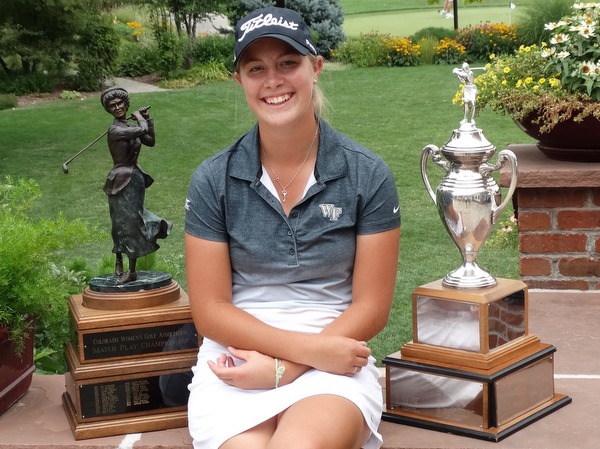 — Jennifer Kupcho (Golf Person of the Year): The 19-year-old from Westminster, the CWGA Player of the Year in both 2014 and ’15, took another big step in 2016.
She finished sixth individually in the women’s NCAA Championship finals and qualified for the U.S. Women’s Open, arguarbly the top women’s golf tournament in the world. Kupcho also swept the CWGA Match Play and Stroke Play titles, becoming the first player to do so in 12 years. In winning by huge margins in 2016 (12 and 10 in the Match Play final, and by 19 shots in the Stroke Play), she became the first golfer since the 1980s to win three straight CWGA “majors”. And earlier this month, the Wake Forest sophomore won her first individual title at a college tournament, breaking a Demon Deacons’ women’s program record with a 15-under-par 201 total at the Ruth’s Chris Tar Heel Invitational, where she prevailed by six strokes.
— Rick Polmear (Lifetime Achievement Award): Polmear, a University of Michigan Evans Scholar alum who has lived in Colorado since 1981, has long been a tireless supporter of the college scholarship for caddies. But he took that support to a new level as the volunteer project manager for the $6 million University of Colorado Evans Scholars house renovation and expansion project, which was completed early this year.
Polmear estimates he devoted about 1,000 hours to the project over the course of three years. The end result is a house almost totally redone on the inside, the addition of roughly 2,000 square feet of finished space (bringing the total to about 18K), and a nifty new outdoor area behind the house that features a combination lighted basketball/volleyball court and a congregating area with brick pavers that Polmear refers to as a “plaza”. All in all, it’s been a huge upgrade for the 50-plus current CU Evans Scholars.
Polmear has served as a volunteer director for the Western Golf Association — which administers the Evans Scholarship nationwide — since 1990.
By the time the USGA and R&A released their 2016 edition of the Rules of Golf on Oct. 26, CGA executive director Ed Mate had already returned from meetings in Far Hills, N.J., that began to set the stage for the next edition.
Basically, it’s an ever-evolving process, and the personnel working behind the scenes on such matters come and go.
Mate (left), who’s headed up the staff of the CGA since 2000, is one of the newcomers to the Rules of Golf decision-making process.
In fact, with his recent appointment to the USGA Rules of Golf Committee, he becomes the first CGA staff member to ever serve on the committee. He’s one of five advisory members on the 13-member committee as he’s filling the slot reserved for a representative of the state and regional golf associations. Former CWGA executive director Robin Jervey served in that same position several years ago.
Being the first CGA staffer on the USGA Rules of Golf Committee “is not a compliment to me, but to the CGA,” Mate said. “We have a good reputation” with the USGA.
Indeed, two living Coloradans have been presidents of the USGA, Will Nicholson Jr., and Judy Bell. And in the last quarter-century, several other residents of the Centennial State have served on the powerful USGA Executive Committee, including M.J. Mastalir, Jim Bunch and Christie Austin.
Nicholson has been a fixture on the USGA Rules of Golf Committee since 1974 and is among those currently serving alongside Mate. Other Coloradans who have been on the committee in the relatively recent past are Mastalir, Bunch and Austin, all of whom have chaired the committee, and Jervey. Austin was the first female chair of the Rules of Golf Commitee, which works with the R&A in establishing and interpreting rules standards worldwide.
For Mate, having a hand in the process is a dream come true.
“I’m very excited to be on the committee,” he said. “I can tell you how welcome I felt and how sincere (others on the committee) were in welcoming my input. I didn’t know what to expect, but I have every opportunity to contribute.”
The invitation to serve on the committee came from a person with whom Mate is very familiar, Thomas Pagel. Pagel has been the USGA’s senior director of Rules of Golf & Amateur Status since 2011. He worked on the CGA staff from 2003-08 and was the assistant executive director of the association for two years until being named executive director of the Utah Golf Association in 2008.
Pagel asked Mate during this year’s U.S. Women’s Open if he’d like to join the USGA Rules of Golf Committee. And, after checking with the CGA board, Mate couldn’t say yes quickly enough.
“It’s pretty much a no-brainer for me,” he said. “I’m a self-proclaimed Rules geek. I’ve always been interested in the Rules since I got involved in the game. So to be part of process is amazing.”
The USGA Rules of Golf Committee, along with its R&A counterpart and their executive committees, are currently attempting to streamline the Rules as much as is practical.
“The stated objective is to find a way to simplify the Rules,” Pagel said on Oct. 26. “That’s our primary focus moving forward. … Are there wholesale ways to help simplify it?”
The USGA Rules of Golf Committee typically includes advisory reprepsentatives from the PGA of America, the Mexican Golf Federation, the PGA and LPGA Tours, and from state and regional golf associations. They and the rest of the committee normally meet three times per year.
To read about the changes made for the 2016 edition of the Rules of Golf, CLICK HERE.
It’s been more than 250 days since it started raining at CommonGround Golf Course on Sept. 10, but who’s counting?
Well, maybe the staff and the regular players at the Aurora-based public facility are, along with the folks at the CGA and CWGA, which own and operate the course.
Ever since those 14.5 inches of rain fell in the area around CommonGround in the six days beginning on Sept. 10 — which is nearly the average total Aurora receives annually — things haven’t been quite the same at the place.
The flooding — which at one point covered nearly half the course in water, in some places 6 feet deep — took its toll. The Tom Doak-designed course, which opened five years ago this month, had eight holes substantially damaged by standing water, some of which covered the turf for weeks before draining completely. The eight affected holes were on the west side of the property: Nos. 5, 6, 7, 11, 12, 13, 14 and 15. The turf on five greens died: 5, 6, 11, 12 and 14. (The 12th green is pictured at left during the reconstruction process in early April.)
But things are just about to get back to normal at CommonGround. After the championship course operated as a nine-hole facility for roughly the last eight months, all 18 holes are expected to fully reopen to the public on June 1 (next Sunday), though selected events will use the full 18 in the days just prior.
It’s something director of golf Dave Troyer and his staff eagerly await.
“It will be nice to get back to our normal routine and start trying to climb back up,” he said. “We had gotten to a really good point, then were kicked back down, and now we’re getting back up on the horse. So we’re excited to do that.”
CommonGround, home to many community-outreach and “for the good of the game” programs, will take the next step in its return to normal on Thursday (May 29) at the Colorado Golf Foundation Golf Tournament it’s hosting. The purpose of the day is threefold: One is to celebrate next weekend’s reopening of the entire 18-hole course; another is to dedicate the 21,700-square-foot community putting green; and one is serving as the annual fundraiser that benefits the Colorado Golf Foundation-supported programs at CommonGround. Those include the Solich Caddie & Leadership Academy, the Hale Irwin Elite Player Program, the Colorado PGA Golf in Schools Program and CommonGround’s community partnerships. The Colorado Golf Foundation serves as a funding arm for youth development programs.
All in all, it’ll be a big day.
“When you’re operating at 50 percent of capacity, you have 50 percent of the customers through the door, you have 50 percent of the people hanging out,” noted Ed Mate, longtime executive director of the CGA. “Fortunately, our junior golf programming has not been impacted. We do the field trips, we do the Golf in Schools programs, the outreach stuff, the training of the caddies. All that’s occurred on the nine-hole Kids Course and on the (championship course) holes we have open.
“So fortunately our programming hasn’t been impacted by 50 percent. But the whole energy of the place has been cut significantly. So to get back is very exciting — and particularly this early. We had thought about July, but (instead) it’s going to be a full golf season as far as we’re concerned.”
The community putting green (left), located north of the 18th hole at CommonGround, originally was scheduled to be dedicated on Oct. 4 of last year. But the September flooding changed that.
The concept behind the community putting green is simple.
“It’s further advancement of ‘a place for all and all the game teaches’,” Mate said, echoing the motto for CommonGround Golf Course. “There’s nothing more for everyone than a putting green that doesn’t cost anything to use. And it’s a community putting green. At the very beginning when we contemplated owning and operating our own golf course, the community putting green was something that really was a critical part of it. It epitomizes the purpose: a place for everybody. Everybody can putt. Not everyone can hit a golf ball, but everybody can putt. It is absolutely fabulous, and it’s up to us to make the best use of it. It is really, really cool.”
Mate credits former CGA president M.J. Mastalir, a visionary for CommonGround, for the concept behind the community putting green.
“What’s the difference between this putting green and the putting green that people use to practice putting on?” Mate asked rhetorically. “It’s much more undulating. It’s not going to be maintained at the same speed — it will be a little bit slower. We’ll probably have some 15-inch holes cut in it. And its purpose is really to introduce people to golf — or at least the putting part of golf. Down the road we might use it for SNAG golf (a popular learning system). We don’t really know. We’ll just let the creativity of our programming dictate it. The main distinction is it’s not — underline, bold-faced — not a practice amenity for those who want to come over and work on their short games. It’s there for the community and as an extension of our junior golf laboratory.”
The community putting green wasn’t impacted by the flooding in September, but a lot of work and expense has been involved in reconstructing the affected portion of the championship course.
Troyer said there have been about $350,000 in “hard costs” of repairs, and the lost revenue has been projected at $750,000 to $850,000. But sodding the affected greens early in the spring (pictured at top) will allow CommonGround to open a month earlier than if they had been seeded.
“All our regulars are just super excited to get playing the full 18 again,” Troyer said. “I think there’s a really good buzz going on.”
In recent days, Troyer, Mate and other officials examined the flood-affected holes. Their observations? The sodded greens are smooth and in very good condition, though they are currently softer and a little slower than the other greens on the course. Regarding the areas outside the green complexes, there are some thin spots in the grass, but considering three of the five most affected holes are par-3s (Nos. 6, 12 and 14), the impact should be minimal. And winter rules will be utilized on the five holes (5, 6, 11, 12 and 14). And once CommonGround gets some dry heat for a stretch, everything should quickly fill in nicely.
“The fairways, the rough and the surrounds of the greens — the cool weather has set us back a little bit,” Troyer said. “But I was fairly surprised how much grass is out there actually. It looks like a golf course. We’ll play winter rules (on the affected holes) for however long it takes, but you can definitely find a lie pretty much anywhere within 2-3 inches of where your ball ends up.”
The grand reopening comes on the heels of some additional national exposure CommonGround recently received for one of its flagship programs — the Solich Caddie & Leadership Academy, which is beginning its third season.
The Golf Channel did a feature on the Academy last year, and last week it aired an update and refresher about the program. Mate was interviewed two months ago for the recent story that was carried on “Morning Drive”.
“There’s only one thing that I’m aware of that’s put the Colorado Golf Association on Golf Channel, and it’s been (the Solich Caddie & Leadership Academy),” Mate said. “Everything else we do as a golf association isn’t that unique. I’m not saying it’s not important, it’s just not that unique. What we’re doing at CommonGround, no other state or regional golf association is doing. And it’s pretty cool to have that opportunity to share what we’re doing and spread the word.”