(Note: This is the first in an occasional series of U.S. Mid-Amateur articles that will appear on ColoradoGolf.org leading up to the national championship for players 25 and older being held at Colorado Golf Club and CommonGround Golf Course Sept. 14-19.)
It should go without saying that winning a USGA national championship is no easy task. And that’s even more the case for a resident of Colorado, where the population isn’t huge — relatively speaking — and trying to play golf year-around can be problematic.
All that said, when lifelong Coloradan Bill Loeffler was departing for the U.S. Mid-Amateur in the fall of 1986, his father-in-law, Ron Moore, made a bold prediction.
“It’s weird,” Loeffler said last week in reflection. “My father-in-law, Ron Moore, told my wife that he thought I was going to win the tournament when I was leaving for Mississippi, just because we had played a couple of times together.”
And, sure enough, Moore proved prescient regarding Loeffler, now a member of the Colorado Golf Hall of Fame, like Moore. Loeffler, then 30, would go on to win the 1986 U.S. Mid-Am, which drew 2,511 entrants. The event was played at Annandale Golf Club in Madison, Miss., a Jack Nicklaus-designed course that hosted a PGA Tour event for 20 years until 2014. Loeffler defeated Georgian Charles Pinkard 4 and 3 in the scheduled 18-hole championship match on Oct. 9, 1986.
Loeffler (above in a USGA photo from the ’86 championship) remains the only Coloradan to have won the U.S. Mid-Am, which dates back to 1981.
As much as Loeffler has accomplished in the game — he’s also won three Colorado Opens (tied for second-most ever, behind Dave Hill), the 1992 national PGA Assistant Professional Championship, the 2007 Senior PGA Professional National Championship, a Colorado Senior Open, a CGA Amateur and three Colorado PGA Section Champioships — he points to the 1986 U.S. Mid-Am victory as the most meaningful in his long career.
“It’s probably the best accomplishment I can think of — only because of what the Mid-Am did for me,” said Loeffler, now 62. “Not only was it a USGA championship, but it got me on the Walker Cup team (in 1987) and then into the Masters (in 1988). It was a springboard. Anytime a golfer gets a chance to win a USGA event, it’s a pretty big deal. I can’t think of anything bigger” that he’s accomplished in golf.
Indeed, though the U.S. Mid-Am victory didn’t automatically earn him a spot on the Walker Cup team or into the Masters back then, that was the de facto result of his victory in Mississippi. Coloradan M.J. Mastalir, then a member of the USGA Executive Committee, pushed for Loeffler’s inclusion on the 10-man Walker Cup team, and Loeffler ended up going 2-1 individually as the U.S. routed Great Britain & Ireland in the matches in England.
And at the time, the Masters invited the entire U.S. Walker Cup team into its field, which is how Loeffler competed at Augusta National in 1988. In the department of fortuitous timing, that was the last time an entire American Walker Cup team was invited to the Masters. On the other hand, since 1988 every U.S. Mid-Am winner has been invited to the Masters, and since 2017, the Mid-Am champ has landed a spot in the following year’s U.S. Open.
At the ’86 Mid-Am, Loeffler rode a very hot Ping putter to the title. Besides defeating Pinkard in the final, Loeffler topped one of the world’s top amateurs at the time, Randy Sonnier, 3 and 2 in the semis. Sonnier was a finalist — losing to Jay Sigel — and a stroke-play co-medalist the only previous time the U.S. Mid-Am has been contested in Colorado, in 1983 at Cherry Hills Country Club.
“That week I was really on my game,” Loeffler said of the ’86 Mid Am. “I remember putting just out-of-the-planet good. It was a great golf course, good on my eye and I was just making everything. I got past (a couple of past Walker Cuppers in match play) and I was pretty thrilled with that because I knew they were the cream of the crop in amateur golf.”
Asked specifically about the final against Pinkard, Loeffler (left in a USGA photo) said he has few specific recollections.
“I just remember being in a fog the whole finals, like it didn’t matter what he did or where I hit it, I kind of knew I was going to win,” Loeffler said. “And it was WEIRD. I used to get pretty volatile, but that day it was just surreal, like I was floating through the match and it didn’t matter what he did. If he’d have thrown three birdies at me, it wouldn’t have mattered.”
Loeffler’s 4 and 3 victory ties for the second-most-lopsided margin in an 18-hole U.S. Mid-Am final. He only had to play the 18th hole once in the match-play portion of the event. And at 30, he was the event’s youngest champion at the time.
Loeffler knew something special might be in the works during the practice days — specifically when he got into a putting contest on the practice putting green with fellow former Arizona State University golfer Dennis Saunders.
“We spent a couple hours on the putting green,” Loeffler recalled. “Honest to God, I started making these putts — 50 feet, 30 feet, 20 feet. I was like, ‘What in the world is going on here?’ But they just started pouring in. We got done and Dennis said, ‘I have never, ever seen you putt like this before.’ I said, ‘I don’t know what’s going on but I’m going to try to keep this feeling for the whole week.’ And it worked.”
In fact, that Ping putter worked so well that week that the manufacturer — as has been the case since the 1970s for each major victory with a Ping putter — made a gold-plated putter with the exact specs of the one used to win the tournament and stored in a company vault at Ping headquarters in the Phoenix area.
While his putting was spot on that week, Loeffler had to manufacture a tee-to-green game to a certain extent.
“I remember getting down there and being unable to hit a draw, no matter what I was doing,” he said. “In the practice rounds playing with a couple of my ASU teammates, I finally just decided, ‘You know what? I’m not even going to fight it. I’m just going to aim down the left side and cut it — just let it work that way.’ And of course on a Nicklaus course if you cut it, sometimes it’s an advantage. I did that all week — hit this ugly kind of cut/slice thing, hit a bunch of greens and putted great. For the life of me, I couldn’t turn the ball over right to left.”
Even after winning the national title, Loeffler was frustrated with that situation to the point that he rectified it within a few days of returning to Colorado.
“When I got home from the championship, I went down to Castle Pines into their club room and decided I didn’t like the shafts in my irons so I reshafted all of them,” he said. “I was so mad I couldn’t turn the ball over. I figured it had to be the shafts; it couldn’t be me. It was just impetuous and stupid.
“I was in the club repair room and Keith Schneider (then the PGA head professional at Castle Pines) and Jack Vickers (the club founder) were having a meeting. Of course, when you change shafts you have to heat the shafts up a little bit. So I set off the smoke alarm in the clubhouse with Vickers and Keith in there in a meeting. Keith comes and just looks at me, shook his head and walked away.”
Loeffler’s golf career has been an unusual one given that he’s gone from amateur to pro to amateur to pro. After winning a state high school title at Cherry Creek, a CGA Junior Match Play and CGA Amateur in Colorado before becoming an All-American at ASU, Loeffler turned pro the first time and made it to the PGA Tour. He competed on golf’s top circuit in 1980, ’81 and early ’82, playing in 32 events. But he made only eight cuts and $5,356 during that time.
“I had a plan and got on Tour,” Loeffler said. “I set some goals and wasn’t achieving them. I wanted to kind of get on with my life, I wanted to get married to Sandy. She had her job and she wasn’t traveling with me. I stopped enjoying playing golf and I wasn’t getting better. I kind of decided, I love the game, but there’s something else to do. … It was time for a change.”
So even though he had some PGA Tour status remaining in 1982, he decided after playing poorly in U.S. Open qualifying that he’d start the process for regaining his amateur status. Three years later, he was an amateur again and played in the CGA Match Play — where he lost to eventual champion, and now longtime PGA Tour/PGA Tour Champions player, Brandt Jobe — and in the CGA Amateur.
In 1986, Loeffler won the U.S. Mid-Am, then captured the inaugural CGA Mid-Amateur title and a third Broadmoor Men’s Invitation victory the next year. But after playing on the ’87 Walker Cup team and in the ’88 Masters as an amateur — where he shot 77-79 and missed the 36-hole cut — Loeffler returned to the professional ranks in 1989, this time on the club professional side of things.
“I remember playing in the Pacific Coast Amateur in Seattle and I was pretty much broke,” he said. “It had cost say about $1,000 to play it. I finished second or third to Billy Mayfair. I was sitting at the podium and they gave me a medal about the size of a half-dollar. I looked at it and I’m like, ‘I’m starving to death, my wife thinks I’m a loser and I’ve got this half-dollar medal. I realize now my whole life is centered around golf, so it’s time for another change.’ I went back and said, ‘Sandy, I’ve got to turn pro.’ And she supported me, like she always has.”
During this second stint as a pro — which has lasted the last 30 years — Loeffler has been an owner of The Links Golf Course in Highlands Ranch and Moore, Loeffler, wife Sandy and their family built and operated the Hale Irwin-designed Highlands Ranch Golf Club from its opening in 1998 until 2011, when it was gifted to the University of Denver. And obviously Loeffler has accomplished plenty as a competitor.
But Loeffler (left in a CGA photo in 2018) has been hampered by a bad back for quite a while now, to the point that he believes his days of competing in multi-day tournaments may be behind him.
“It’s hard for me to be able to play two rounds in a row, so I think I’m pretty much done (from a competitive standpoint),” he said. “It’s my back. It gets real weak after about 12 holes. (After) two or three days, I’ve got to go on some pain meds, and I hate doing that. It’s just time. Fifty years of competing, that’s plenty. I think I’m done.”
But Loeffler still enjoys rounds of casual golf with wife Sandy, who has taken up the game, and friends.
“It’s all good,” he said. “If I play twice a week and separate the two days, I’m OK.”
And if his days competing in major events is indeed done, Loeffler has put together a stellar resume, including the 1986 U.S. Mid-Am title. And he’s happy to see the event returning to his home state this year.
“It’s tremendous. And to have it at Colorado Golf Club, one of the best clubs in the state, just a great golf course, it doesn’t get any better than that,” he said. “And it’s a great match play course with those finishes on those par-5s, 15 and 16. It’s going to be tremendous. I’m sure the field will be chock-full of ex-pros that are just great players. And in September, it’ll be perfect (weather-wise).”
]]>Over the years, 10 different clubs have advanced to the finals of the Team Interclub. And half of those have made at least two finals appearances. But the two clubs that have qualified for the finals most of all are The Broadmoor Golf Club in Colorado Springs and Rifle Creek Golf Course in Rifle.
And guess who the two 2018 finalists are who will square off on Oct. 20 at CommonGround?
That’s right — The Broadmoor and Rifle Creek.
The Broadmoor will be making its fourth appreance in the finals and Rifle Creek its third. But the only time either club has actually won the title was in the one previous year that they squared off in the finals, 2014. The Broadmoor earned the trophy that year with a 23-13 victory. This year will mark the first time two teams have met twice or more in the Interclub finals.
(For the record, the other three clubs that have made the Team Interclub finals more than once are Lone Tree, Todd Creek and Battlement Mesa. And Lone Tree remains the only two-time champion of the event, having won in 2011 and ’12, though The Broadmoor would give LT company should it beat Rifle Creek next weekend.)
The CGA Team Interclub stands apart among CGA championships. Every other championship on the schedule is contested over the course of one to four days. The Team Interclub, on the other hand, typically lasts five months or more, with a regular-season round-robin of geographically-linked groups of teams going from May through July, then a 16-team single-elimination playoff from August to October.
Both in the regular season and the playoffs, teams of eight golfers each — of widely varying abilities — square off, with net singles and net four-ball matches held concurrently. Each individual match is worth two points — two for a win and one for a tie. Rosters can vary throughout the season.
This year’s original CGA Team Interclub field featured 32 teams, up six from last year. The record number of team entrants for the event was 64 in 2013. Notably, both Rifle Creek and The Broadmoor come from the two round-robin groups that are the furthest from Denver.
Two changes took effect for this year’s Team Interclub — going from teams of 12 to teams of eight, and teams are now comprised of four “A” players of low handicap indexes of 9.9 and under and four “B” players of low handicaps between 10 and 20.
Both clubs in this fall’s Team Interclub finals are undefeated going into the last match of the year, with The Broadmoor being 6-0 and Rifle Creek 5-0-1, with the tie coming against Battlement Mesa during the regular season.
The Broadmoor is the top seed in the playoff bracket, having scored more points in the regular season (57) than any other club, but it was tested in getting to the finals. Representatives of the Colorado Springs-based resort course edged Lone Tree and Elmwood by 14-10 margins in the round of 16 and the quarterfinals, respectively, before beating The Meadows 16-8 in the semifinals. The Broadmoor’s previous finals appearances came in 2014, ’15 and ’16.
Seventh-seeded Rifle Creek, a public course that also made it to the finals in 2012 and ’14, defeated Broken Tee Englewood 17-7 in the round of 16 and Mariana Butte 16-8 in the quarterfinals. Then in the semis, RC ousted defending Team Interclub champion Saddle Creek/Murphy Creek, 16-8.
When The Broadmoor and Rifle Creek met in 2014 for the title, it was the first of three straight final appearances for the Colorado Springs club. The 23-13 win gave The Broadmoor a 7-0 record that 2014 season. In fact, it won all seven of its matches by double-digit margins.
Four Broadmoor players on that winning team in 2014 will compete again in the finals on Oct. 20: Mike Allred, Ron Crowder, Roger Perry and Scott Meagher. And five Rifle Creek competitors from that 2014 runner-up team are back: Jeb Savage, Tod Smith, Mark Sours, Michael Higginbotham and Pat Hays.
The Team Interclub finals will conclude the 2018 CGA championship season.
CGA Team Interclub Finals Pairings
Singles
Mike Allred (B) vs. Jeb Savage (RC)
Curtis Olson (B) vs. Tod Smith (RC)
Ron Crowder (B) vs. Cole Manupella (RC)
Luke Travins (B) vs. Eric Copen (RC)
Joe Diver (B) vs. Mark Sours (RC)
Roger Perry (B) vs. Michael Higginbotham (RC)
Tom Haggard (B) vs. Tim Roe (RC)
Scott Meagher (B) vs. Pat Hays (RC)
Four-Ball
Allred/Olson (B) vs. Savage/Smith (RC)
Crowder/Travins (B) vs. Manupella/Copen (RC)
Diver/Perry (B) vs. Sours/Higginbotham (RC)
Haggard/Meagher (B) vs. Roe/Hays (RC)
Road to the 2018 CGA Team Interclub Finals
THE BROADMOOR
Regular Season (3-0 with 57 points)
— Defeated The Club at Flying Horse 18-6
— Defeated Garden of the Gods Club 15-9
— Defeated Colorado Springs Country Club 24-0
Playoffs
— Round of 16: Defeated Lone Tree 14-10
— Quarterfinals: Defeated Elmwood 14-10
— Semifinals: Defeated The Meadows 16-8
RIFLE CREEK
Regular Season (2-0-1 record with 45 points)
— Defeated Glenwood Springs 15-9
— Tied with Battlement Mesa 12-12
— Defeated Lincoln Park 18-6
Playoffs
— Round of 16: Defeated Broken Tee Englewood 17-7
— Quarterfinals: Defeated Mariana Butte 16-8
— Semifinals: Defeated 2017 champion Saddle Rock/Murphy Creek 16-8
For more information on the CGA Team Interclub, CLICK HERE and go to CGA Team Interclub tab.
]]>Some of the best players in the state age 13 and under competed in the event, with the designated “Team Europe” (pictured) defeating Team USA 19-13 after three sessions of matches.
While the USA won Sunday’s 18-hole singles session, 9-7, Europe had built a commanding lead in the team portion of the event, winning the nine-hole four-ball and the nine-hole foursomes — both held on Saturday — by 6-2 margins in each case.
Ҭ
Out of the 32 juniors who competed in the Junior Ryder Cup, just four won all three of their matches — Emily Cheng (USA), Caitlyn Chin (Europe), Wes Erling (Europe) and Frank Lockwood (Europe).
Junior Ryder Cup ResultsӬ
At CommonGround GC in AuroraӬ
OVERALL SCORE: TEAM EUROPE 19, TEAM USA 13
Sunday’s 18-Hole Singles (USA 9, Europe 7)
Emily Cheng (USA) def. Hadley Ashton, 1 up
Liam Wood (USA) def. Matai Naqica, 2 and 1
Kaitlin Zingler (Europe) def. Gisella Lagrimas, 4 and 3
Charlie Flaxbeard (USA) halved with Blake Sullivan
Caitlyn Chin (Europe) def. Brooke Hudson, 4 and 3
Wes Erling (Europe) def. Luke Cushman, 4 and 3
Ashleigh Wilson (USA) def. Logan Hale, 2 up
Carter Surofcheck (USA) halved with Yusuke Ogi
Colin Young (Europe) def. Andrew White, 4 and 3
Frank Lockwood (Europe) def. Tiki Jaffe, 3 and 2
Ben Chin (USA) def. Jack Chambers, 6 and 5
Will Balliet (USA) def. Grant Samuelson, 4 and 3
Livia Pett (Europe) def. Addison Hines, 1 up
Miles Kuhl (USA) def. Andre Dumonteil, 2 and 1
Maddie Makino (USA) def. Taylor Wilson, 2 and 1
Clint Summers III (USA) def. Brayden Destefano, 1 upӬ
Saturday’s 9-Hole Four-Ball (Europe 6, USA 2)”¨
Naqica/Sullivan (Europe) def. Wood/Flaxbeard, 2 and 1
Erling/Yogi (Europe) def. Cushman/Surofcheck, 1 up
White/Balliet (USA) def. Young/Samuelson, 2 and 1
Chambers/Lockwood (Europe) def. B. Chin/Jaffe, 3 and 2
Cheng/Lagrimas (USA) def. Ashton/Zingler, 3 and 2
C. Chin/Hale (Europe) def. Hudson/A. Wilson, 2 and 1
Dumonteil/Destefano (Europe) def. Kuhl/Summers, 1 up
Pett/T. Wilson (Europe) def. Hines/Makino, 2 and 1
Saturday’s 9-Hole Foursomes (Europe 6, USA 2)
Naqica/Sullivan (Europe) def. Wood/Flaxbeard, 1 up
Erling/Ogi (Europe) def. Cushman/Surofcheck, 2 and 1
Young/Samuelson (Europe) def. A. White/Balliet, 1 up
Chambers/Lockwood (Europe) def. B. Chin/Jaffe, 2 up
Cheng/Lagrimas (USA) def. Ashton/Zingler, 1 up
C. Chin/Hale (Europe) def. Hudson/A. Wilson 1 up
Domonteil/Destefano (Europe) def. Kuhl/Summers, 1 up
Hines/Makino (USA) def. Pett/T. Wilson, 1 upӬ
For the top players age 14-18, on tap is the fourth Colorado major of the year, the JGAC Tour Championship, set for Saturday and Sunday (Oct. 6-7) at Denver Country Club. For the best golfers 13 and under, it’ll be the Junior Ryder Cup team event this weekend at CommonGround Golf Course in Aurora.
Then on Sunday evening, after the conclusion of both events, the JGAC’s season-ending banquet will be held at Denver CC.
At the 36-hole Tour Championship, the field will feature the winners of three 2018 JGAC majors and four state high school titles this year.
The 2018 major junior champions entered this weekend are all on the girls side and include Hailey Schalk of Erie (Colorado Junior PGA), Katie Berrian of Castle Rock (Colorado Junior Amateur) and Lauren Lehigh of Loveland (Colorado Junior Match Play). Lehigh leads the JGAC Girls Junior Tour points list for 2018.
As for entrants who are state high school champions from 2018, there’s Micah Stangebye of Montrose (4A) and Jackson Klutznick of Denver (3A) on the boys side, and Emma Bryant of Aurora (5A) and Schalk (3A) on the girls.
There are also a couple of past JGAC Tour Championship winners entered this weeked — Charlotte Hillary of Cherry Hills Village from 2016 and Schalk from last year. Schalk was the 2017 JGAC Girls Player of the Year.
Others scheduled to compete in the Tour Championship are Colorado Junior America’s Cup player Walker Franklin of Broomfield and 5A runner-up Connor Jones of Westminster and Caroline Jordaan of Lakewood.
One player who won’t be at Denver Country Club is 2018 JGAC Boys Junior Tour points list leader Dillon Stewart of Fort Collins, who won the 5A boys state high school title on Tuesday. Instead, he’s competing in the prestigious Ping Invitational at Karsten Creek in Stillwater, Okla. Coincidentally, he’ll be playing his college golf in Stillwater — at Oklahoma State — starting in the fall of 2019.
For the Saturday pairings from the JGAC Tour Championship, CLICK HERE.
As for the Junior Ryder Cup at CommonGround, kids age 13 and under will battle it out, with teams designated Team USA and Team Europe. There will be three sessions — nine-hole four-ball and nine-hole foursomes on Saturday, then 18-hole singles matches on Sunday.
Among the Junior Ryder Cup competitors will be three winners of 2018 Junior Series Championships — Hadley Ashton of Erie (11-13), Matai Naqica of Centennial (11-13) and Andre Dumonteil of Centennial (10 and under).
For the field for the Junior Ryder Cup, CLICK HERE.
]]>
Jared Reid had modest goals going into the 32nd CGA Mid-Amateur Championship this weekend at CommonGround Golf Course in Aurora.
“This week, honestly, my goal was to make the cut and be top 30 — just so I didn’t have to qualify again for next year’s (Mid-Am),” the 28-year-old from Legacy Ridge Golf Course said.
To say that the Denver resident exceeded expectations — his own and those of others — at the Mid-Am would be an understatement of monumental proportions.
Not only did Reid finish in the top 30 on Sunday, but he won the state title in the tournament limited to players 25 and older. And not only did he win, but he did so while going head to head in the final group with two players who have won five CGA Mid-Ams between them — two-time champ Chris Thayer of Walnut Creek Golf Preserve and three-time winner Jon Lindstrom of Lakewood Country Club.
“Teeing off with those two and they’re announcing all the times they’ve won the championship and runner-ups and everything like that,” noted Reid (pictured above and below). “I’m like, ‘Geez, how am I going to do this today? Hopefully I get out of their way most of the time.'”
Certainly no need to worry about that, as it turned out. And, on top of all that, Reid became just the third player in the history of the championship to finish double digits under par, joining four-time champ Keith Humerickhouse (11 under in 2012) and seven-time winner Rick DeWitt (10 under in 2000).
The victory was the first by Reid in a CGA championship. In fact, he’s only competed in three — two Mid-Ams and the CGA Four-Ball — since moving from Michigan about five years ago.
“This is definitely, definitely” the biggest thing he’s done in golf, he said. “I never won any events in college — just maybe some best balls back home in the Upper Peninsula of Michigan. This is definitely the biggest individual accomplishment I’ve ever had. I couldn’t imagine what the week was going to end up like.”
Reid completed a wire-to-wire performance on Sunday by finishing with a 10-under-par 203 total at CommonGround. He avoided a playoff when Thayer, the defending champion, saw his 9-foot birdie putt on the 18th hole slip just to the right of the cup.
Reid, who played college golf at Northern Michigan University, closed with a 1-under-par 70 on Sunday — the same score as playing partners Thayer and Lindstrom.
After he was tied for the lead with Thayer through nine holes on Sunday, Reid took the lead for good when he sank a 15-foot birdie putt on No. 10. Then he two-putted the par-5 11th for another birdie, giving him three birdies in four holes. And Thayer didn’t help his cause when he slightly pulled his 6-iron second shot and it went into the water on 11, though he did save par on the relatively easy par-5, where the stroke average on Sunday was 4.36.
But Reid’s most impressive shot came on the 495-yard, par-4 15th hole, where a massive drive left him with just 140 yards for his approach shot. He hit a gap wedge to 1 foot for birdie to go two ahead.
Reid then two-putted from 65 feet for par on 16, but bogeyed 17 after going into the greenside bunker on the par-3, leaving him with a one-stroke lead going into the par-5 18th. There, he was right of the green in two and pitched over a bunker complex to 25 feet, two-putting for par.
That gave Thayer (left) a chance to force a playoff, but the 38-year-old couldn’t sink his 9-footer for birdie.
In the last five CGA Mid-Amateurs, Thayer has now finished first, second, second, first and second. He’s posted six straight sub-par rounds in this event, dating back to last year.
“I was happy with the way I hung in there,” Thayer said. “I hit the ball really well, but I missed a 7-footer on 9, a 5-footer on 13 and a 9-footer (on 18). There were a lot of putts like that.
“But Jared played great. He played smart and hit good shots under pressure. He rips it and he hit it really straight all day. With that type of clubhead speed, you could be just a little bit off and they could go a bunch of different directions.
“But this is definitely a bomber’s course. I’m not a bomber, but I’m in the top 20 percent of the field in terms of distance. But these guys that hit it 30 yards by me, it’s an edge for sure.”
Lindstrom (below) will second Thayer’s praise of Reid’s performance this week.
“It’s awesome. The guy hits it a mile,” Lindstrom said. “I had a couple of really good drives and he was 70 yards ahead of me. It’s tough to compete.”
Reid fully acknowledges the difference his driver can make. He wasn’t hitting it well on the front nine on Sunday, but on the back side, it returned to form and he was smacking it long and straight down the stretch.
“My game kind of lives and dies by my driver,” he said. After struggling off the tee in the first half of the round, “the driver was kind of working (starting on the back nine) and I didn’t miss a fairway through the rest of the day, which kept my momentum going. I started feeling good on the tee and I could swing as hard as I could and the ball was going right where I was looking for. I springboarded off that.
“When I’m hitting gap wedge into some of the par-4s and they’re hitting 7- through 5-irons, that’s definitely an advantage.”
Really, it was with nine holes left that Reid had the confidence to feel he could win the title.
“Honestly I’ve only won probably two or three tournaments, even in high school,” he said. “That’s what the most uncomfortable feeling was: Could I finish this off?
“But (after 45 holes) I thought, ‘I might as well just do it since you’ve come all this way.”
Lindstrom, who’s won the title in 2008, ’15 and ’16, finished third for the second straight year, sharing that spot this time at 205 with with former Colorado State University golfer Dominic Kieffer of Collindale Golf Course, who closed with a 68.
At age 51, Lindstrom was the first winner of the Super Mid-Amateur Division for players 40 and older. He was six strokes better than Super Mid-Am runner-up Michael Harrington of Garden of the Gods Club, who likewise posted a 70 on Sunday.
“I’m glad they have the old-man flight now,” Lindstrom said with a smile. “It feels great (to be the first Super Mid-Am champ). I was telling (CGA executive director Ed Mate) they should get us a sponsor like Joint-Ritis or Depends. How about the Depends Super-Senior Mid-Am Flight?”
For all the scores from the CGA Mid-Amateur, CLICK HERE.
]]>
Despite bogeying two of his last three holes on Saturday, Jared Reid of Legacy Ridge Golf Course grabbed a one-stroke lead through 36 holes.
Reid eagled the par-5 11th hole to stand 6 under par for the day, but bogeyed 16 and 17 to shoot a 4-under-par 67. That left him at 9-under 133 overall. Over two days, Reid has played the first 11 holes at CommonGround in 13 under par, and the final seven holes in 4 over.
Reid’s closest pursuers going into Sunday’s final round are both multiple-time champions of this event. Chris Thayer of Walnut Creek Golf Preserve, winner in 2014 and ’17, is in second place at 134 after a second-round 68. Dating back to last year, Thayer has posted five consecutive sub-par rounds in this event. He made four birdies and one bogey on Saturday and has carded just two bogeys in two days. Thayer has two victories and two seconds in the past four CGA Mid-Ams.
Jon Lindstrom of Lakewood Country Club, Mid-Am champ in 2008, ’15 and ’16, holds third place after shooting a 6-under-65 — the lowest round of the tournament so far — on Saturday. His six-birdie, bogey-free day puts him two behind Reid.
Three players share fourth place at 137 — Nick Nosewicz of Meadow Hills Golf Course, former Colorado State University University golfer Dominic Kieffer of Collindale Golf Course and Pete Mangold of Columbine Country Club. Nosewicz, who won the 2015 CGA Match Play at CommonGround, and Kieffer shot 68s on Saturday and Mangold a 69.
The field was cut to the low 40 players and ties after 36 holes, with all those at 8-over-par 150 or better advancing to Sunday.
The Mid-Amateur is limited to players 25 and older, but starting this year, there’s also a Super Mid-Amateur Division for players 40 and older. Through two days, Lindstrom holds a six-stroke lead in that division. Next best after Lindstrom’s 135 are 2014 CGA Player of the Year Michael Harrington of Garden of the Gods Club and Michael Slutzky of Columbine, who are tied at 141.
Reid, Thayer and Lindstrom will tee off for Sunday’s final round at 10:30 a.m.
For all the scores from the CGA Mid-Amateur, CLICK HERE.
The 54-hole event is set for Friday through Sunday (Sept. 28-30). An 84-man field is planned, and the top 40 players and ties after two rounds will advance to Sunday’s action.
Let’s run down some of the top entrants according to their past performance in the event:
— Defending champion Chris Thayer of Golden has two wins and two seconds at the Mid-Am in the last four years.
— Jon Lindstrom of Lakewood Country Club owns three titles (2008, ’15 and ’16) and finished third last year.
— Keith Humerickhouse of Glenwood Springs Golf Club won the Mid-Am four consecutive years (2010-13), becoming just the third player in history to captured the same CGA championship four times in a row.
— Steve Irwin of Lakewood CC has claimed the Mid-Am title twice (2003 and ’05) and contended on numerous other occasions.
— As for those who have yet to win the Mid-Am, Ryan Axlund of Valley Country Club has certainly been impressive, with five consecutive top-10s, including four top-5s. He placed third last year.
And those are by no means the only players who could be in the hunt for the championship come Sunday. There’s 2009 winner Michael Harrington, the 2014 CGA Player of the Year; former Colorado State University golfer Dominic Kieffer; Nick Nosewicz, who won the 2015 CGA Match Play at CommonGround; 2018 U.S. Mid-Amateur qualifier Matt Evelyn; 2008 CGA Amateur champion Jonathan Marsico; and Jeff Chapman.
The list goes on and on.
All told, the winner of every CGA Mid-Am since 2007 — when Robert Polk prevailed — is in the field this weekend.
And this year’s tournament at CommonGround has a new twist. For the first time, players who are 40 and older will also be entered in a Super Mid-Amateur competition. And since the same tees will be used for everyone at CommonGround, those older players can still contend for the overall title.
For Friday’s tee times at CommonGrond, CLICK HERE.
]]>
But in the bigger picture, it shouldn’t be forgotten that the 2019 U.S. Mid-Am national championship will be held at Colorado Golf Club in Parker, with CGA-owned CommonGround Golf Course in Aurora serving as the second course for the stroke-play portion of the event. The dates for that championship are Sept. 14-19, 2019.
For the record, that will be just the second U.S. Mid-Am — which is limited to players 25 and older — ever conducted in Colorado, with Cherry Hills Country Club having hosted the 1983 championship.
As for this year, Charlotte will host the U.S. Mid Am Sept. 22-27. At Tuesday’s qualifying tournament, the 78 contestants will be vying for four spots in the national championship.
Several players who competed in the 2017 U.S. Mid-Am are in the Lone Tree field. That includes five-time national Mid-Am qualifier — and three-time CGA Mid-Amateur champion — Jon Lindstrom, who went to the match play round of 64 last year; 2017 Colorado-based qualifying medalist Ryan Axlund; Pete Mangold; and Walter Koelbel.
Also scheduled to play on Tuesday are 2012 CGA Match Play champion and 2018 Match Play semifinalist Brian Dorfman; 2014 and 2017 CGA Mid-Amateur winner Chris Thayer; four-time CGA Mid-Am champ Keith Humerickhouse; two-time U.S. Amateur qualifier Kyle Danford; 2014 CGA Les Fowler Player of the Year Michael Harrington; Denver City Amateur champion Jeff Chapman; and Alex Kephart.
For Tuesday’s pairings at Lone Tree, CLICK HERE.
Colorado Golf Hall of Famer Janet Moore and part-time Gunnison resident Marilyn Hardy have each competed in dozens of USGA national championships over the years.
They’re all special, but the one they qualified for on Tuesday at CommonGround Golf Course in Aurora really sets itself apart.
The two, along with fellow Coloradan Sherry Andonian-Smith and Texan Patricia Beliard, earned spots in the inaugural U.S. Senior Women’s Open. Years from now, they’ll all be able to reminisce about being part of the field for a first-ever national championship. (Andonian-Smith, Hardy and Moore are pictured at left.)
And it’s an added bonus that the event will be contested at one of the oldest and top-ranked courses in the U.S., Chicago Golf Club, which will host the competition July 12-15.
“This one is very special for me,” said Moore, a Centennial resident who will be playing in her 26th USGA championship. “Normally I don’t get too nervous for qualifiers. I was nervous for this one, and already I’m nervous for the tournament and it’s a month away. This is very special to play in the inaugural U.S. Senior Women’s Open. It’s the biggest (USGA event) I’ve played in.
“My friend Ellen Port (a seven-time USGA champ) is exempt. And she said, ‘Janet, I want you to come out and watch.’ I said, ‘Ellen, I’m going to try to play.’ She’s like, ‘I’m sorry. I forgot.’ I’m anxious to text her and say, ‘Hey, I’m playing too.'”
Added Hardy, a veteran of roughly 36 USGA championships, including two U.S. Women’s Opens: “This is huge. I’m so excited about it. It’s fantastic that they got around to (creating this event). It’s way overdue.”
Andonian-Smith, a Colorado PGA professional from Centennial who’s an instructor at Valley Country Club, earned medalist honors Tuesday at CommonGround with a 1-under-par 71. The 55-year-old played her final seven holes in 3 under par and made four birdies and three bogeys on the day.
That left her with a big smile on her face.
“Honestly I thought my USGA tournaments were done,” said Andonian-Smith, who last competed in a USGA national championship as an amateur — at the U.S. Women’s Amateur and the U.S. Women’s Amateur Public Links — twice each. She was twice a first alternate for the U.S. Women’s Open. “I’m 55 and I’m not going to do the U.S. Open anymore. So when they did this event, I was like, ‘Oh my gosh, I have another chance.’ So I was very excited.
“This is pretty high (on my list of golf accomplishments) because I thought I was done with them. I haven’t slept much the last few nights.”
 Andonian-Smith will also play this year in the Senior LPGA Championship, in October in French Lick, Ind.
Moore, winner of five CWGA Stroke Play Championships in the 1990s, tied for second at 74 on Tuesday despite a double bogey on the final hole. The 53-year old finished with three birdies, three bogeys and the double. Sarah Moore, Janet’s daughter, helped Arapahoe win a 5A girls state high school team title at CommonGround in 2010, and she caddied her for mom on Tuesday.
Speaking of Sarah Moore, she played golf at Wheaton College in Illinois, which is about a 10-minute drive from Chicago Golf Club. Janet Moore coached the Wheaton women’s team for several years, and during that time she had the opportunity to play Chicago Golf Club once.
“It was really hard,” Janet Moore recalled of the historic course. “I think that’s part of my being nervous. Just playing it for fun, it was hard. But it’s a great course, and the history of it is impressive. I’m thrilled to be part of it. It will be a really good challenge.”
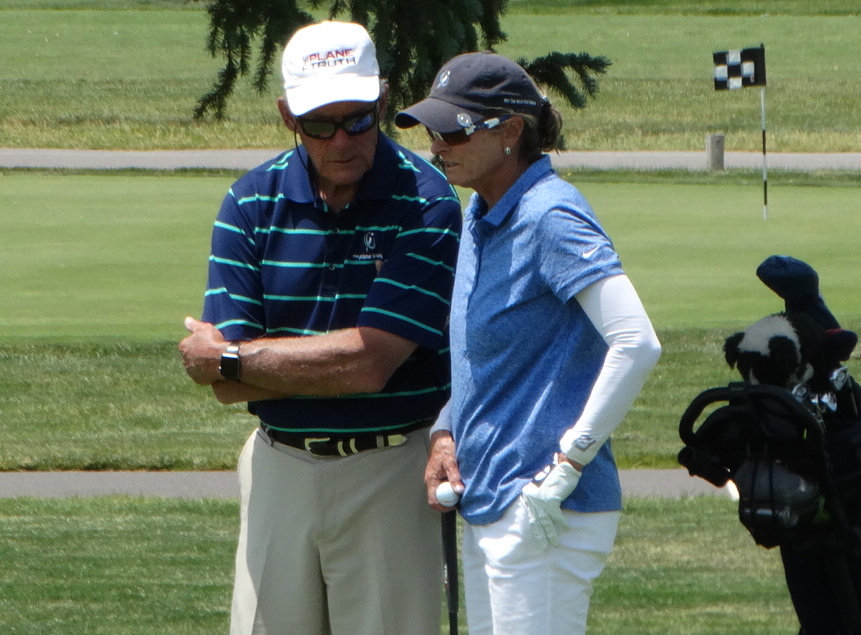
Hardy, 56, who has advanced to the semifinals of the U.S. Women’s Mid-Amateur and to the quarterfinals of the U.S. Senior Women’s Amateur, matched Moore’s 74 on Tuesday after parring her last 15 holes of the day. Hardy and her husband, renowned golf instructor Jim Hardy, live in Colorado during the summer and in the Houston area during the winter. Jim Hardy served as Marilyn’s caddie on Tuesday, and he does likewise in all USGA championships in which she competes. (The two are pictured above.)
Not surprisingly, Marilyn also works considerably with Jim on her swing and her game.
“How could I not?” she said with a smile. “And he’s always right. I keep that in mind. It’s very comforting having him on the bag.”
And Beliard, a native of France who lives part-time in Houston and has played on the Ladies European Tour for most of the last two decades, earned the fourth and final U.S. Senior Women’s Open berth out of Tuesday’s field of 24. Beliard, 54, birdied the last hole of regulation for a 75, then defeated former LPGA Tour players Lori West of Glenwood Springs and Dede Cusimano of Aspen on the first hole of a playoff. Beliard two-putted from the back fringe for par from 30 feet to advance.
Cusimano and West missed the green short on the extra hole, the par-4 first, and neither could convert their 20-foot par putts. Cusimano ended up two-putting for bogey to earn the first alternate spot, while West three-putted for double bogey, leaving her with the second alternate position.
Beliard (left), like the other qualifiers, relishes the fact that she’s part of the first field for the U.S. Senior Women’s Open.
“It’s something that it’s great we have it for the first time and I really want to be part of it,” she said. “It was about time we have the U.S. Senior Women’s Open. I think it’s great. I’ll be very, very happy to play in the first one for sure.”
U.S. Senior Women’s Open Qualifying
At Par-72 CommonGround GC in Aurora
ADVANCE TO NATIONAL CHAMPIONSHIP
Sherry Andonian-Smith, Centennial 71
Janet Moore, Centennial 74
Marilyn Hardy, Gunnison 74
Patricia Beliard, Katy, Texas 75
ALTERNATES (In Order)
Dede Cusimano, Aspen 75
Lori West, Glenwood Springs 75
Kathy West, Tulsa, Okla. 77
For complete scores, CLICK HERE.
At least that’s the case for golfers trying to qualify in Colorado for the inaugural U.S. Senior Women’s Open.
When CommonGround Golf Course in Aurora hosts the Colorado-based qualifier for the event on Tuesday, four players out of a field of 24 will advance to the first U.S. Senior Women’s Open ever held. And there will be three alternates — a change from the typical two for most USGA qualifying events.
The inaugural U.S. Senior Women’s Open is scheduled for July 12-15 at Chicago Golf Club, which is currently ranked No. 14 among Golf Digest’s America’s 100 Greatest Golf Courses. Chicago GC is one of the nation’s oldest 18-hole courses.
The field for Tuesday’s qualifier at CommonGround features many accomplished competitors: Colorado Golf Hall of Famer Janet Moore; Denver native Lori West, who posted six top-10s on the LPGA Tour; former Colorado Women’s Open champions Dawne Kortgaard, Shelly Rule and Shannon Hanley; Coloradan Sherry Andonian-Smith, who finished second in the senior division of the LPGA Teaching & Club Professionals National Championship in September, earning a spot in the 2018 Senior LPGA Championship in the process; Elena Callas King, longtime instructor at CommonGround who was named among the top 50 LPGA teachers worldwide by the LPGA Teaching and Club Professionals membership; part-time Colorado resident Marilyn Hardy, a past semifinalist in the U.S. Women’s Mid-Amateur; former CWGA Stroke Play winner Kristine Franklin; and past CWGA Senior Match Play and Senior Stroke Play champion Deb Hughes.
Already in the U.S. Senior Women’s Open field is part-time Colorado resident Hollis Stacy, a World Golf Hall of Famer and three-time U.S. Women’s Open champion. The 64-year-old has a 10-year exemption by virtue of winning a U.S. Women’s Open title. Only four women have won more USGA national titles than has Stacy (6): JoAnne Gunderson Carner (8); Anne Quast Sander (7); Carol Semple Thompson (7); and Ellen Port (7).
“I will be playing, (trying) not to make a mess of it,” Stacy wrote to coloradogolf.org in an email earlier this year.
For Tuesday’s pairings at CommonGround, CLICK HERE.